A 3-Step Framework for STEM Magnetic Tiles Learning
 Priya RamanSenior Analyst
July 27, 2026 — Recent shifts in early childhood education emphasize the use of open-ended tools like STEM Magnetic Tiles to bridge the gap between simple play and foundational engineering.
Selecting the right tools for three-year-olds requires a focus on hands-on learning, creativity, and problem-solving, as noted by Smart Kids Planet in their 2026 assessment of early STEM adoption. At this developmental stage, children transition from basic tactile exploration to purposeful construction. By utilizing a structured approach to these toys, parents can foster spatial reasoning and fine motor skills simultaneously. Think of it as a matrix of complexity, where the child moves from 2D patterns to 3D structures.
The Three-Axis Growth Model

Photo by cottonbro studio on Pexels
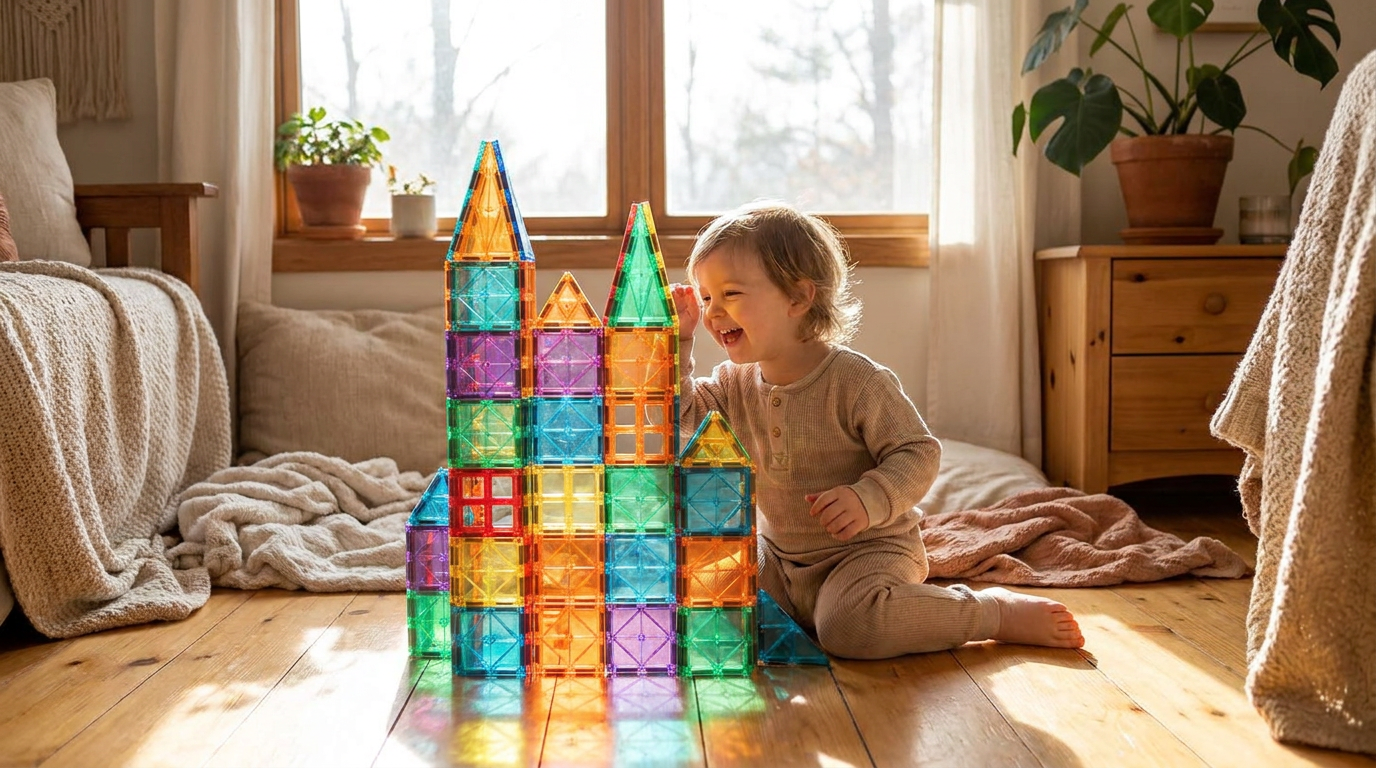
When introducing STEM Magnetic Tiles to a three-year-old, the progression should follow three distinct axes: Dimensionality, Functionality, and Collaboration. In the Dimensionality phase, the child begins with flat 'mosaics' on the floor, learning how magnets attract and repel. As they move toward the Functionality axis, they incorporate specialized pieces, such as those found in a magnetic tiles car expansion pack, to understand motion and stability. Finally, the Collaboration axis involves building larger structures that require planning and shared goals. The decision rule is simple: if a child is struggling with vertical height, revert to 2D patterns to reinforce the magnetic connection mechanics before attempting a complex tower. This ensures the child remains engaged without the frustration of structural collapse. Data from recent classroom observations shows that magnetic tiles for kids are most effective when used in sets that offer high-transparency colors and reinforced rivets for safety. These sets often see higher engagement rates in kindergarten settings because they allow for open-ended play that evolves with the child's skill level.
Expert tip: Use the magnetic tiles car expansion pack to teach the concept of a 'low center of gravity'; building a wide base for vehicles prevents tipping and introduces basic physics during play.
Integrating these activities into daily routines is essential, and many of these building techniques are also applicable when considering travel friendly toddler activities that keep children occupied in confined spaces. Because these tiles are easy to stack and pack, they are ideal for travel friendly toddler activities where space is at a premium. Once you see it this way, every play session becomes a lesson in architectural integrity.