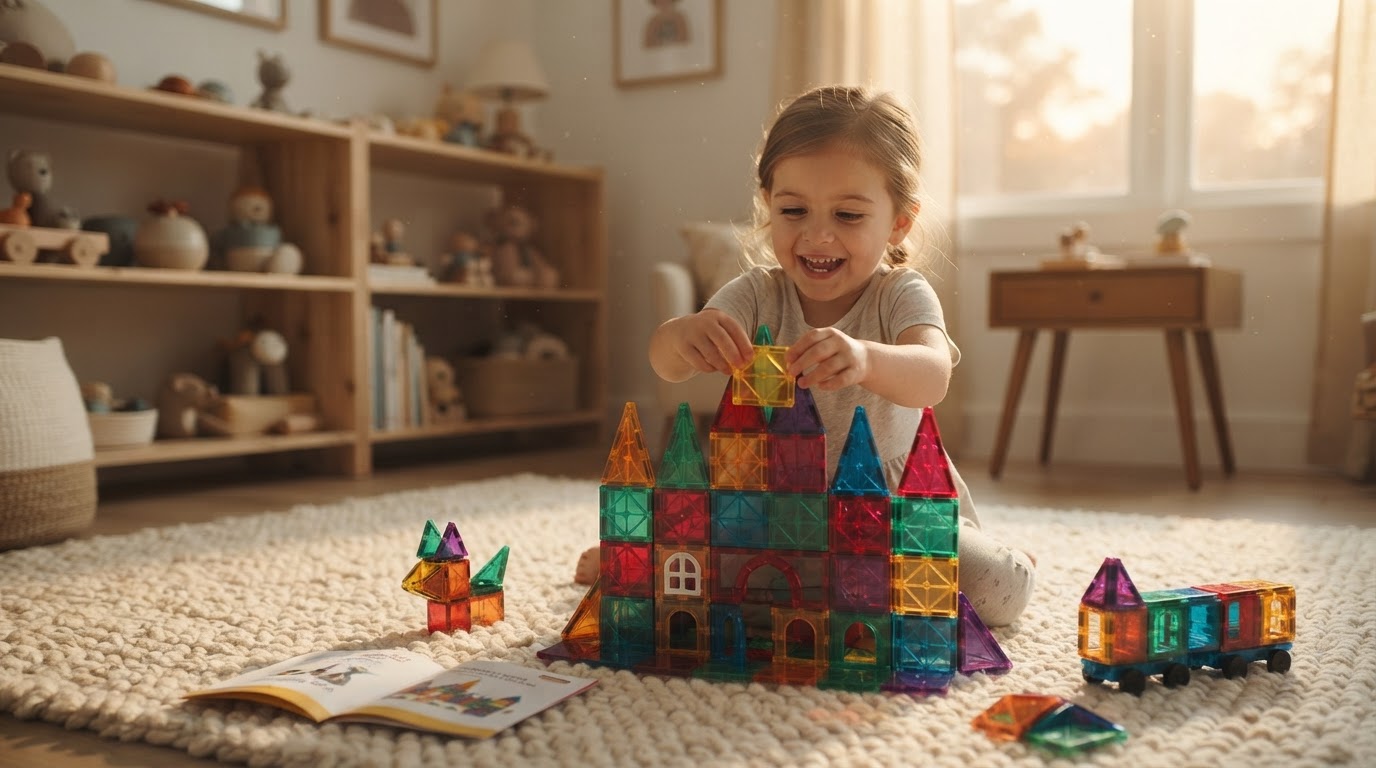
Creative STEM Magnetic Tiles Activities for Three Year Olds
 Priya RamanSenior Analyst
October 14, 2026. This analysis explores specific structural frameworks for utilizing magnetic building sets to enhance early childhood cognitive development. It is designed for caregivers and educators seeking to maximize the utility of STEM Magnetic Tiles during the critical developmental window of age three.
Effective play at this age can be understood through a matrix of two developmental axes: physical dexterity and spatial reasoning. Three-year-olds are transitioning from simple tactile exploration to purposeful construction, making the choice of materials vital. According to Stories of Play, engaging a toddler with magnetic tiles can be as simple as using a household object like a tissue box for a "posting" activity, where tiles are dropped through a slot to develop fine motor skills and object permanence. However, as children progress, the need for more complex open ended toys for 3 year olds becomes evident. The primary challenge for parents is providing a toy that is sufficiently simple for a toddler to manipulate independently while offering enough complexity to sustain interest as their skills evolve. Without a structured approach, these tiles often remain scattered on the floor rather than being used as tools for architectural discovery. The goal is to move beyond the "dump and scatter" phase into the "build and test" phase, where the child begins to understand how geometric shapes like squares and triangles interact to create stable 3D forms.
STEM Magnetic Tiles address these developmental requirements by providing a high-friction, high-magnetism interface that compensates for the still-developing motor precision of a toddler. When selecting the best magnetic tiles for toddlers, the strength of the internal magnets is the most critical variable. Stronger magnets allow a three-year-old to build vertically without the frustration of structural collapse, which is essential for maintaining engagement. For those specifically looking for stem toys for 3 year olds, these tiles serve as a foundational introduction to geometry and physics. The tiles are designed with reinforced plastic and secure rivets to ensure safety during the inevitable "demolition phase" of toddler play. By using these tiles, children can experiment with the "ball run" concepts often seen in best magnetic blocks for toddlers reviews, where gravity and momentum are introduced through play. The decision rule for implementing these tiles involves starting with 2D "flat-lays" on the floor—creating patterns and mosaics—before encouraging the child to pull the shapes upward into 3D cubes. This progression mirrors the natural cognitive shift from recognizing shapes to understanding volume.
Once you see it this way, the transition from simple play to structured learning becomes a repeatable framework. The decision framework for maximizing the value of these tiles depends on providing the right environment and prompts. Caregivers should focus on the following checklist to ensure the activity remains both educational and safe:
- Prioritize base plates to provide a stable foundation for vertical towers.
- Integrate non-magnetic items like small figurines or cars to encourage narrative-driven play.
- Limit the number of pieces to under 45 for initial sessions to prevent sensory overwhelm, as suggested by Alice at @pandamommyteacher on Instagram.
- Demonstrate the "click-and-pull" technique to help the child understand magnetic polarity.
- Rotate tile shapes weekly to force new problem-solving strategies, such as using only triangles to build a dome.
Shop STEM Magnetic Tiles here: https://stemmagnetictiles.com
Sources
- Alice | Magnetic Tiles Play Ideas (@pandamommyteacher) - Instagram
- The No. 1 Toy in Our House: 10 Ways My Kids Play With Magnetic Tiles
- 43 Magnetic Tiles Games & Activities for Kids ideas - Pinterest