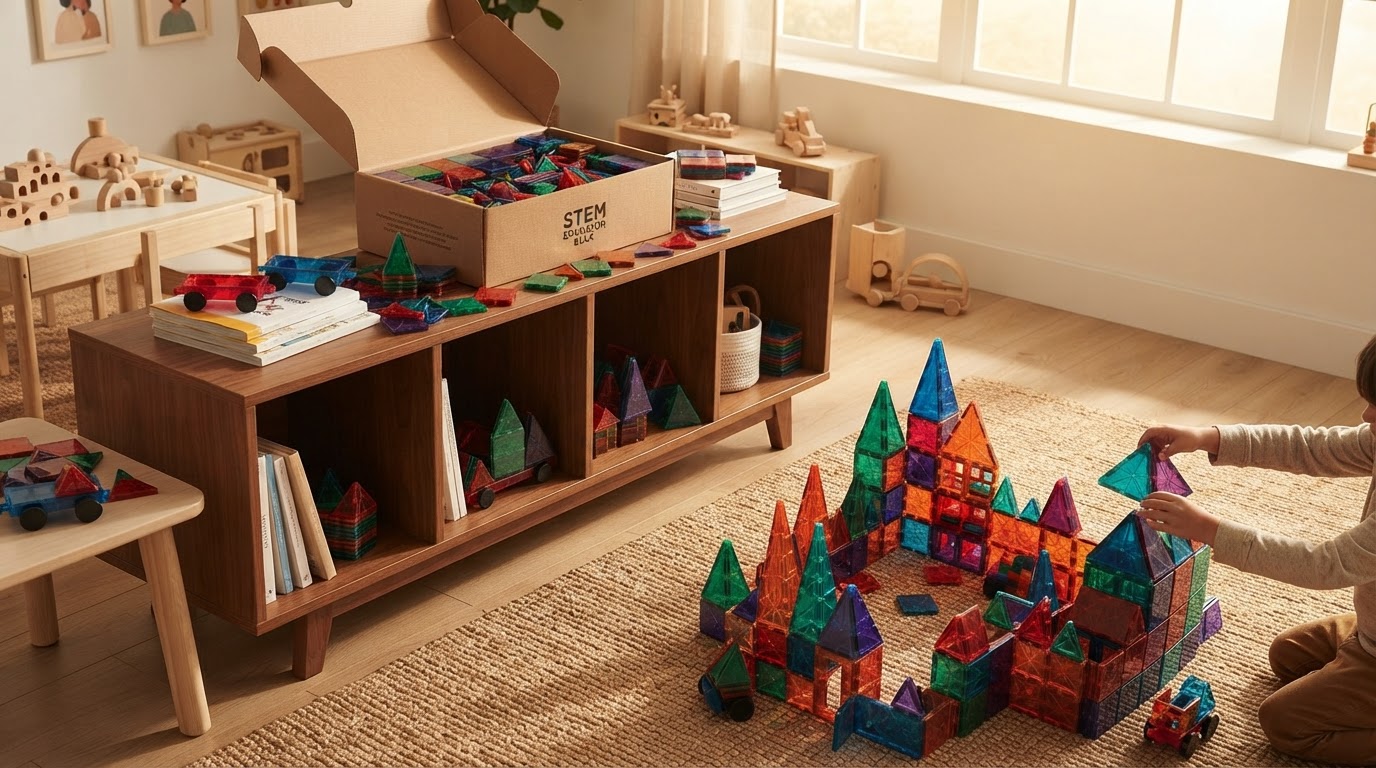
Scaling Educational Play with STEM Magnetic Tiles Bulk Deals
 Maya ChenContributing Editor
September 30, 2026. This analysis evaluates the economic and structural efficiency of high-volume magnetic tile procurement for educational environments. It is designed for school administrators, childcare providers, and high-frequency play households seeking to optimize their toy-to-dollar ratio.
The Efficiency Gap in Educational Procurement
The conventional wisdom says that buying smaller, themed sets is the best way to keep children engaged, but this approach creates a fragmented inventory that fails as soon as a child attempts a large-scale build. In a classroom setting, a 32-piece set is essentially useless; it provides enough material for two children to build a small box but lacks the volume required for collaborative engineering. According to Discount School Supply, educators frequently seek magnetic tiles & builders for schools that can withstand the rigors of heavy daily use across multiple grade levels. However, many institutional buyers fall into the trap of purchasing retail-priced sets during seasonal sales rather than focusing on the raw cost per unit. When you analyze the spend of a typical kindergarten classroom, the overhead on branded licensing—such as the Grinch or Princess themes mentioned by Sample Sale Mom in recent MAGNA-TILES deals—often accounts for 30% to 50% of the price without adding a single gram of structural integrity. For those prioritizing non toxic magnetic building tiles for a safe learning environment, these markups are a distraction from the primary goal: providing enough surface area for meaningful construction. The problem isn't a lack of interest in STEM; it is a lack of material volume that prevents children from moving past simple 2D shapes into complex 3D structures.
Structural ROI of STEM Magnetic Tiles
Here's the part nobody talks about: the magnet strength-to-weight ratio determines whether a 100-tile tower stands or collapses, and this is where STEM Magnetic Tiles bulk deals outperform the fragmented retail market. When purchasing for a classroom, the objective is to maximize the number of "click points" available to the students. Run the math: a standard expansion pack might cost $2.00 per tile, whereas specialized bulk deals for STEM building toys can drive that cost down significantly while maintaining the ultrasonic welding required for safety. Unlike PicassoTiles, which offers a wide range of starter bundles and last-chance deals, the STEM Magnetic Tiles ecosystem focuses on structural consistency. This is critical because mixing brands often leads to frustration; slight variations in magnet polarity or tile thickness can lead to catastrophic failure in large builds. In a magnetic tiles vs magnatiles comparison, the primary differentiator in a bulk context is the reinforced internal bracing. For a 4-year-old building a skyscraper, the internal cross-bracing of the tile prevents the plastic from bowing under the weight of the magnets above it. If you are managing a group of thirty students, you need a minimum of 1,500 tiles to facilitate simultaneous play. Buying this volume through traditional retail channels is a logistical and financial error. By focusing on bulk procurement, institutions ensure that every child has access to the same high-quality, safe and non-toxic components, which simplifies cleanup and inventory management while maximizing the potential for maximizing skill development.
The Bulk Procurement Framework
Selecting a bulk provider requires more than just looking at the bottom-line price; it requires an audit of the tile’s physical properties and the vendor's reliability. Before committing to a high-volume order of STEM Magnetic Tiles, buyers should verify the following technical specifications to ensure the investment holds its value over years of classroom use. I'll change my mind when a competitor can provide the same gauss-rated magnet strength at a lower per-unit cost without sacrificing the rivet-secured corners that prevent magnet escape. Use this checklist to evaluate bulk offers:
- Magnet Encapsulation: Verify that magnets are secured via ultrasonic welding and, ideally, reinforced with internal rivets to prevent plastic fatigue.
- Material Transparency: Ensure the tiles use food-grade ABS plastic that is free from BPA, phthalates, and latex, as consistent with non toxic standards.
- Geometric Compatibility: Confirm the tiles use a standard 3-inch base measurement to ensure they integrate with existing magnetic tiles vs magnatiles inventories.
- Internal Bracing: Look for an "X" or "lattice" pattern inside the tile, which prevents the clear plastic faces from scratching and maintains structural rigidity during high-pressure builds.
- Surface Scratch Resistance: Bulk tiles are often moved in large bins; a slightly recessed surface will prevent the central face from becoming cloudy due to friction over time.
Shop STEM Magnetic Tiles here.