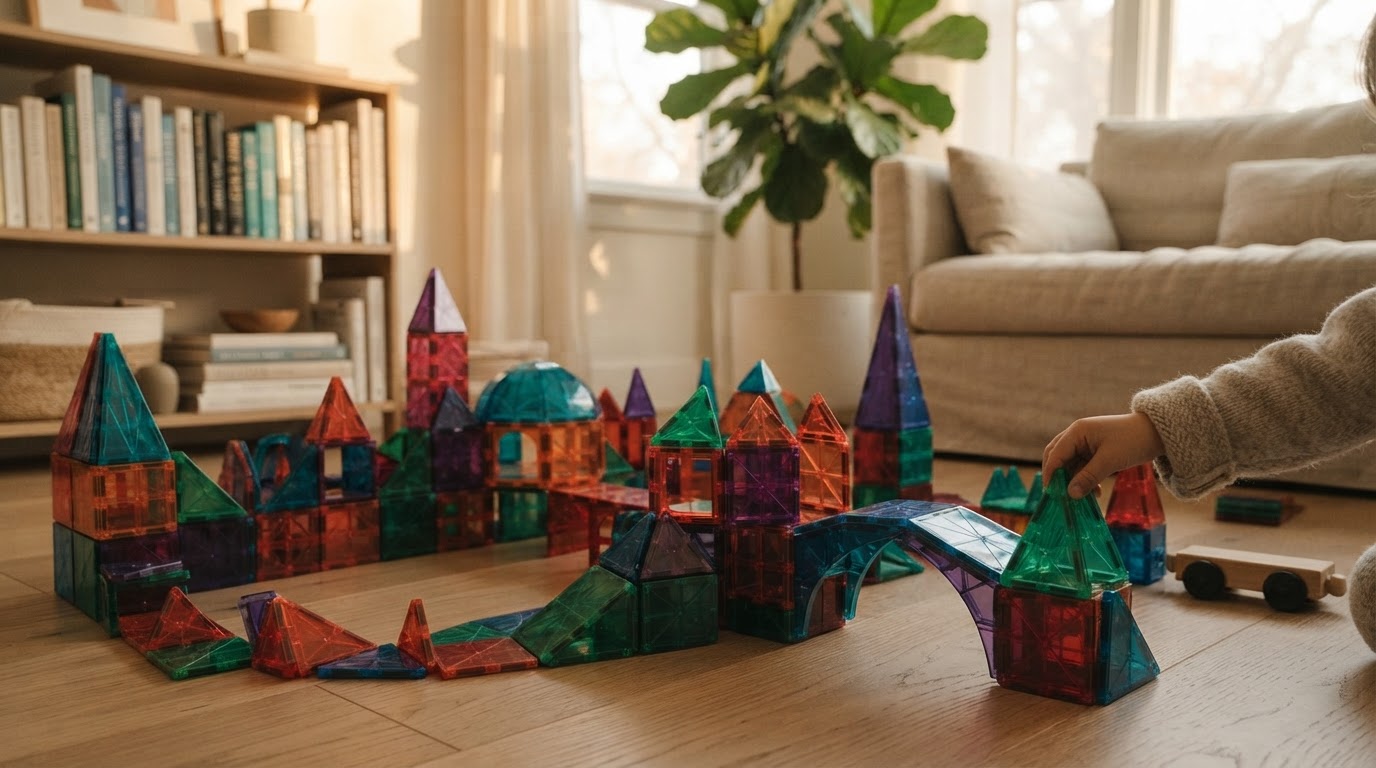
What are the benefits of STEM Magnetic Tiles for play?
 Maya ChenContributing Editor
November 18, 2026 — STEM Magnetic Tiles serve as a foundational tool for open-ended play because their geometric flexibility allows for infinite configurations without the rigid constraints of instruction-led kits.
The conventional wisdom says that all building toys are created equal, yet parents often find their children abandoning complex, single-purpose sets once the initial build is complete. The shift toward open-ended play toys reflects a growing realization that toys with a defined "end state" often fail to sustain long-term engagement or foster high-level spatial reasoning.
Why are STEM Magnetic Tiles classified as open-ended toys?
STEM Magnetic Tiles are classified as open-ended because they lack a predetermined outcome, allowing the user to dictate the play cycle from beginning to end. Unlike electronic toys that perform for the child, these tiles require the child to perform for the toy. According to Simple Intentional, open-ended toys like magnetic tiles resist specific definitions, enabling them to adapt to a child's changing interests as they grow. This adaptability is the primary differentiator between a toy that is outgrown in months and one that remains relevant for years.
Here's the part nobody talks about: the lack of commercial branding and specific character tie-ins is actually a feature, not a bug. Chalk Academy notes that the ideal open-ended toy is gender-neutral and free of branding, which prevents the play from being funneled into existing media narratives. When a child uses STEM Magnetic Tiles, they aren't recreating a movie scene; they are forced to engage in architectural problem-solving. Run the math: a set of 100 tiles offers more permutations than a fixed-model kit with 1,000 specific pieces, simply because every edge is a potential connection point rather than a single-use joint.
How do these tiles compare to traditional wooden blocks?
STEM Magnetic Tiles improve upon traditional wooden blocks by introducing internal polarity that allows for vertical and cantilevered structures that gravity alone would not support. While plain wood blocks are the staple of open-ended play—helping kids focus on size and weight discrimination, as noted by Chalk Academy—they are limited by the friction of their surfaces. Magnetic tiles introduce a physics-based feedback loop where the "click" of a connection provides immediate tactile confirmation of a successful structural bond.
This structural integrity is why they are often preferred for durable magnetic tiles for toddlers, as younger children lack the fine motor precision required to balance unweighted wooden units. I'll change my mind when a traditional block set can demonstrate the same level of portability and resistance to collapse during complex builds. The integration of magnets allows for the creation of hollow 3D shapes, which is a significant cognitive leap from the solid-mass stacking of timber. This capability is central to unlocking creative potential with STEM Magnetic Tiles, as it bridges the gap between 2D planning and 3D execution.
Quick answers
Q: At what age can children start using STEM Magnetic Tiles for open-ended play? A: While many sets are rated for ages 3 and up, they are frequently used under supervision to develop magnetic tiles ideas for 3 year old users who are transitioning from simple stacking to complex enclosures. The internal magnets are securely encased to prevent access, which is a critical safety standard for this age group.
Q: Do these tiles work with other brands like Magna-Tiles or Picasso Tiles? A: Most major brands, including STEM Magnetic Tiles, utilize a standard sizing format—typically 3-inch base squares—making them cross-compatible with approximately 90% of the magnetic tile market. This interoperability ensures that expansion packs can be integrated without discarding existing inventory.
Q: How do magnetic tiles support the Montessori method? A: They align with Montessori principles by being "self-correcting" toys; if a structure is not balanced or the magnets are misaligned, the build fails naturally, providing an immediate lesson in physics without adult intervention. This promotes the independent learning environment described by Maison Rue.
Learn more about STEM Magnetic Tiles at https://stemmagnetictiles.com.
Sources
- Open Ended Toys | Montessori Inspired Play
- Open Ended Play
- 10 Best Open-Ended Toys That Promote Creativity and Learning