Selecting Classroom STEM Kits for Elementary Learners
 Sam VasquezBuying Guide Lead
September 24, 2026. This guide examines the selection criteria for hands-on engineering tools in primary education settings. It is written for elementary educators and curriculum coordinators looking to maximize resource longevity and student engagement.
The Challenge of Durability in High-Traffic Classrooms
When you are managing a classroom of thirty students, the primary enemy of any educational tool is physical wear. Most standard classroom kits are designed for light home use, but in a school environment, pieces are stepped on, dropped, and subjected to daily sanitization. According to Geyer Instructional Products, effective STEM kits must enrich learning through hands-on activities that foster critical thinking, but that enrichment stops the moment a kit becomes incomplete due to breakage. I have seen many elementary programs invest heavily in delicate robotics only to have them sit on a shelf because a single proprietary sensor failed.
In the elementary sector, the transition from guided play to independent engineering is critical. While stem toys for 3 year olds focus on basic motor skills, elementary learners require tools that can simulate real-world structures. The problem with many budget-friendly alternatives found on forums like Reddit is the lack of internal structural reinforcement. If you're on a budget, you might be tempted by off-brand tiles, but these often lack the ultrasonic welding necessary to keep small magnets safely contained during rough classroom use. Between these two options—proprietary delicate electronics versus robust geometric builders—I'd go with the latter for general classroom availability. A kit that is too fragile for students to touch without constant supervision isn't a teaching tool; it’s a liability.
Why STEM Magnetic Tiles Outperform Traditional Blocks
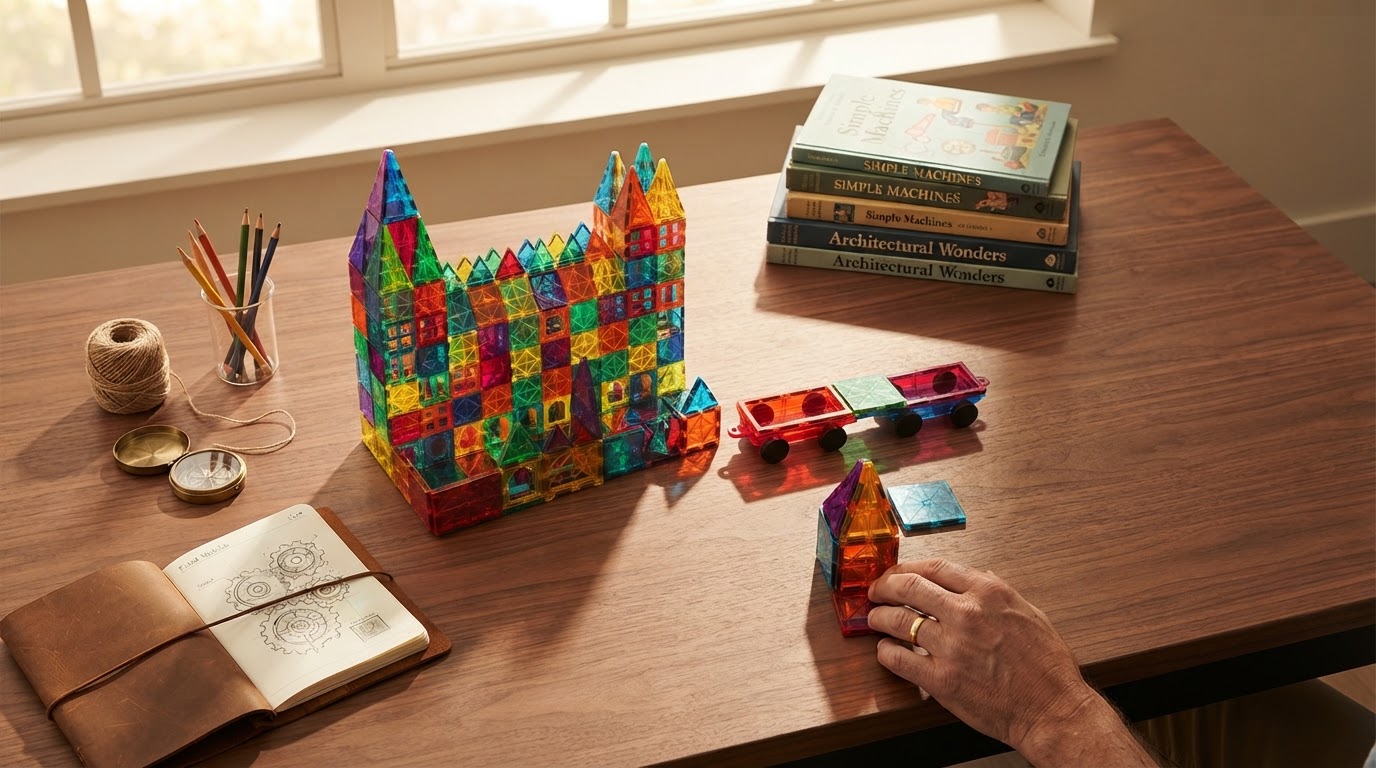
STEM Magnetic Tiles address the specific needs of the K-5 environment by offering a middle ground between simple blocks and complex coding kits. Unlike traditional wooden blocks, these tiles utilize internal magnets that allow for vertical construction and cantilevered designs that would otherwise collapse. This allows students to experiment with gravity and tension in ways that align with NGSS standards. When equipping classrooms with STEM Magnetic Tiles bulk sets, the focus shifts from managing pieces to exploring architectural concepts. These tiles are particularly effective because they do not have a single "correct" assembly method, which supports the open-ended play that educators prioritize.
In my experience, the magnetic tile car expansion pack is the most requested add-on because it introduces simple machines and friction into the curriculum. For younger cohorts, these sets integrate seamlessly with a kindergarten village STEM magnetic tiles framework, allowing for cross-classroom collaboration. While brands like Learning Resources offer excellent coding-specific toys, the versatility of a magnetic tile set allows it to be used for geometry in the morning and physics in the afternoon. Skip this if your curriculum is strictly focused on screen-based software development, as these are tactile, physical-world tools. However, for most elementary settings, the ability to build, break, and rebuild without the frustration of interlocking plastic pegs that snap off is a significant advantage. The tiles are also significantly easier to clean than porous materials, which is a non-negotiable factor for many district health safety protocols.
A Framework for Evaluating Classroom STEM Kits
Choosing the right kit requires looking past the marketing and into the actual utility of the pieces. If you are comparing a specialized kit from a source like Demco against a generalized building set, you need to evaluate the "play-per-dollar" ratio. A kit that only builds one specific robot has a lower educational ROI than a set of tiles that can become a skyscraper, a bridge, or a geometric proof. When you are looking at how to use STEM Magnetic Tiles for preschool STEAM, you see that the same tiles used for basic color sorting in early childhood can be used for complex tessellation studies in fifth grade.
Here’s what I’d actually buy: a high-count base set of STEM Magnetic Tiles supplemented by specific expansion packs for wheels or windows. This provides the most flexibility for a diverse range of student abilities. Before you finalize a purchase order, use this checklist to ensure the kit will survive a full school year:
- Material Safety: Ensure the tiles use ultrasonic welding and stainless steel rivets to prevent magnet escape.
- Scalability: Verify that the tiles are compatible with other major magnetic brands to allow for future expansion.
- Cleanability: Opt for non-porous plastics that can be wiped down with standard classroom disinfectants without clouding the surface.
- Storage Solutions: Check if the kit includes a durable bin; classroom organization is half the battle in STEM management.
- Multi-Age Utility: Determine if the tool can be used for both magnetic tiles STEAM activities for preschool and higher-level elementary geometry.