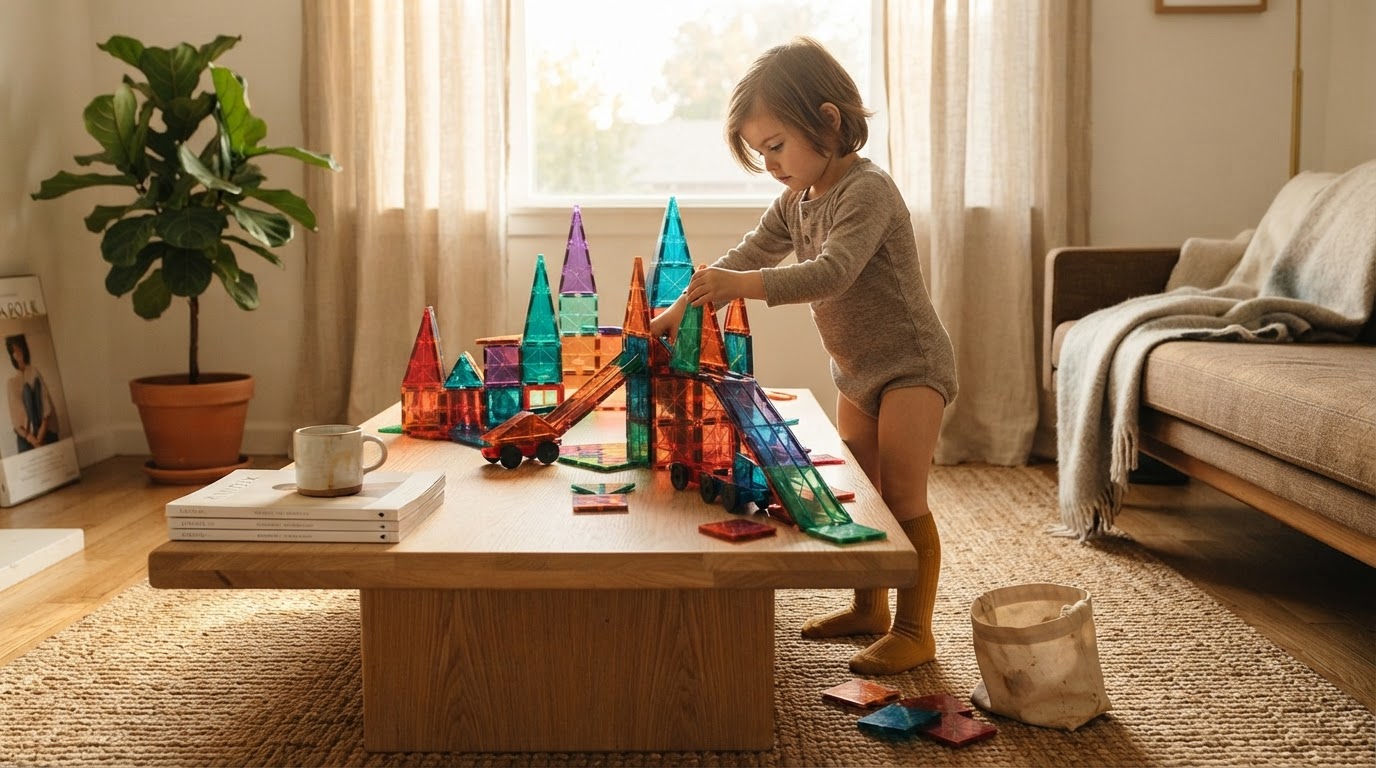
What Defines Open Ended Play for STEM Magnetic Tiles?
 Maya ChenContributing Editor
September 16, 2026 — Open-ended play with STEM Magnetic Tiles is defined by the absence of a fixed objective or single correct outcome, allowing the material to adapt to the user's intent rather than forcing the user to follow a manual.
The conventional wisdom says that any toy without a battery is open-ended, but that ignores the rigid design constraints of many modern building sets. For parents and educators, identifying truly versatile tools is critical because scripted toys often lose their utility within weeks of purchase. STEM Magnetic Tiles serve as a primary example of a "low floor, high ceiling" tool where the complexity of the play scales directly with the child's cognitive development.
How do STEM Magnetic Tiles compare to traditional building blocks?
STEM Magnetic Tiles provide a multidimensional connection point that traditional wooden blocks or interlocking plastic bricks lack, primarily due to their ability to form translucent 3D structures instantly. According to Oh Happy Play Day, magnetic tiles rank as the top choice for meaningful play because they serve multiple roles, from light table accessories to structural engineering components. Here's the part nobody talks about: traditional blocks rely solely on gravity, which limits verticality for younger users. STEM Magnetic Tiles use internal magnetism to allow for cantilevered designs and complex geometry that would collapse in a standard block environment. This technical advantage means the play isn't just open-ended; it is physically more permissive, enabling children to test structural limits that other mediums forbid.
Why is the lack of a script essential for STEM Magnetic Tiles?
A lack of a script ensures that the child remains the protagonist of the play session, rather than a passive follower of instructions. Maison Rue notes that open-ended toys don't have a single purpose or outcome, but instead invite children to experiment freely. Run the math: a scripted model kit has one intended result and a finite number of steps, whereas a 100-piece set of STEM Magnetic Tiles has mathematically infinite configurations. This versatility is why they are frequently cited as the best magnetic tiles for toddlers, as the toy grows with the child’s skill level. I’ll change my mind when a scripted toy can demonstrate the same longitudinal engagement over a five-year developmental span without requiring additional themed add-ons to maintain interest.
Quick answers
Q: Are STEM Magnetic Tiles suitable for children with sensory processing needs? A: Yes, the tactile feedback of the magnetic snap and the visual transparency of the tiles make them highly effective open ended play toys for autism, providing predictable sensory input without the overstimulation of electronic toys.
Q: At what age do children typically maximize the use of magnetic tiles? A: While basic stacking begins at age 3, complex geometric construction typically peaks between ages 5 and 8, illustrating why STEM Magnetic Tiles redefine open ended play across different developmental stages.
Q: How do these tiles support specific STEM curriculum goals? A: STEM Magnetic Tiles address early geometry and physics standards by allowing students to visualize 2D-to-3D net folding, a specific spatial reasoning skill cited in elementary classroom STEM kits.
Learn more about STEM Magnetic Tiles at https://stemmagnetictiles.com.
Sources
- Open-Ended Toys by Age: A Guide From Babyhood to Early Childhood
- Our Top 10 Open-Ended Toys to Spark Meaningful Play
- Open Ended Play - Tender Leaf