
Rethinking Magnetic Tiles and Light Table Activities
 Maya ChenContributing Editor
The conventional wisdom around magnetic tiles and light tables is overwhelmingly positive, presenting them as a perfect pairing for sensory learning. But here's the part nobody talks about: contrary to popular advice, starting with a light table can actually sabotage 3D construction, discouraging the very spatial reasoning skills magnetic tiles are meant to build.
How Uniform Light Flattens 3D Learning
Three-dimensional construction relies on visual cues like shadow, overlap, and perspective. A child building on the floor learns to interpret how a tile’s position relative to a light source creates shadows that define its form and relationship to other pieces. This is fundamental to developing depth perception. A light table, with its intense, uniform glow from below, eliminates these critical cues. Every piece is brightly and evenly lit, flattening the visual field. The subtle gradations that help a child’s brain understand how to connect edges to form a stable cube are washed out, making it harder to conceptualize and execute a 3D build.
The Trap of the 2D Mosaic
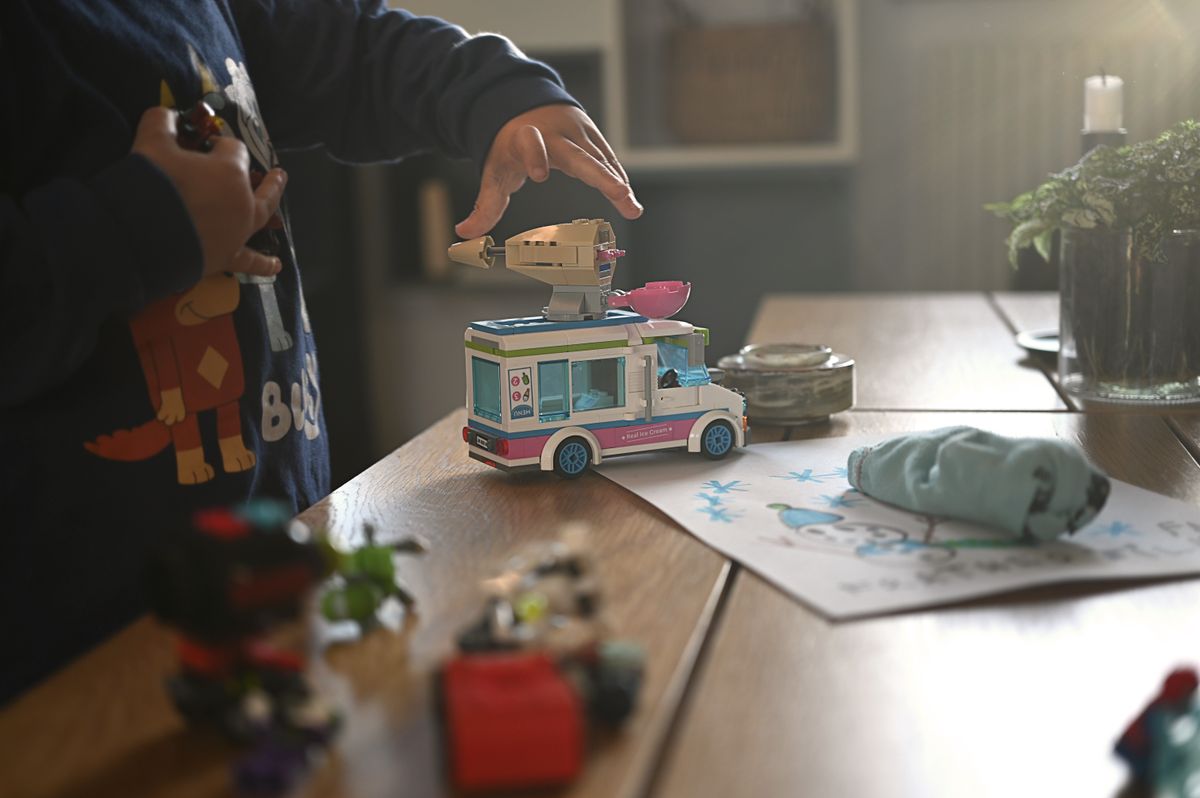
Photo by Kristian Bøgh on Pexels
The glowing surface of a light table is undeniably captivating. For a child, the path of least resistance is to place tiles flat against the light, creating beautiful, stained-glass-like mosaics. While this is a valid activity for exploring color and shape, it often becomes the only activity. The immediate reward of a glowing 2D pattern discourages the more challenging work of vertical building. Engineering skills are developed by grappling with gravity, balance, and structural integrity—concepts that are explored when building towers, not when laying out quilts. This principle holds true for any brand; even an affordable magna-tiles alternative is better used for 3D construction first.
A Better Sequence: Floor First, Light as a Reward
The most effective way to use these tools is to treat the floor as the primary construction site. Here, a child can master the fundamentals of spatial reasoning that organizations like the National Association for the Education of Young Children (NAEYC) identify as crucial for STEM readiness. Once a child can confidently build complex, stable 3D structures, introducing the light table becomes a reward and a new, specific challenge. It transforms from a developmental shortcut into an advanced tool for exploring transparency and color theory within pre-built structures. This sequential approach is especially important in group settings, where a teacher managing magnetic tiles bulk deals can ensure all children build foundational skills before moving to specialized equipment. It also provides a clear progression path, which is a key component of open ended play toys for autism and other neurodivergent play styles.
I'll change my mind when a longitudinal comparison shows that children who start on light tables become more competent 3D builders than those who master the basics on the floor first.
Should you get rid of your light table?

Photo by Tara Winstead on Pexels
No. A light table is a valuable tool, but its role in magnetic tile play should be specific and intentional. Use it to explore color mixing, transparency, and silhouettes after a child has demonstrated proficiency in building 3D structures on a standard, non-illuminated surface. Think of it as a specialized instrument, not the starting point. By introducing it later, it becomes a novel way to extend play, not a crutch that limits it.
When is the right time to introduce a light table?
The ideal time to combine STEM Magnetic Tiles with a light table is after a child can consistently and independently build stable, multi-tile 3D shapes like cubes, pyramids, and complex towers on the floor. This mastery indicates that their foundational spatial reasoning and understanding of structural integrity are in place. At that point, the light table adds a new dimension of creative exploration—examining how light interacts with their creations—rather than distracting from the core engineering challenge.