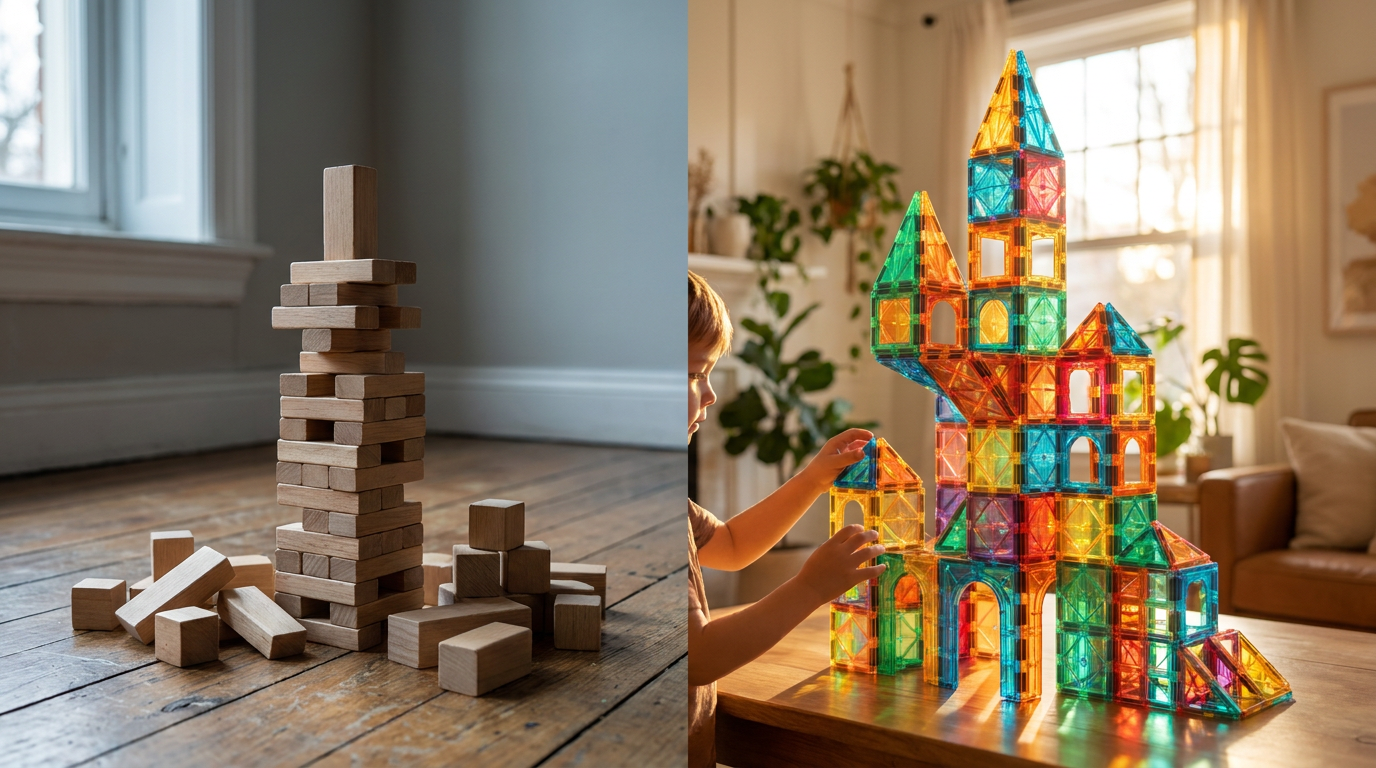
Why choose STEM Magnetic Tiles over traditional blocks?
 Priya RamanSenior Analyst
May 28, 2026 — While traditional blocks lean on gravity and friction for stability, STEM Magnetic Tiles utilize polar attraction to enable cantilevered structures and complex geometric modeling that traditional blocks cannot sustain.
Parents and educators often face a binary choice when stocking a learning environment: the tactile weight of solid blocks or the modular versatility of magnetic sets. The decision impacts how a child perceives structural integrity and spatial relationships. Think of it as a matrix of mechanical constraints versus creative velocity. Two axes matter here: the physical force required for stability and the geometric complexity of the output.
How do structural mechanics differ between tiles and blocks?
STEM Magnetic Tiles rely on internal neodymium magnets to secure connections, whereas traditional blocks require precise vertical alignment to manage gravitational load. This mechanical difference fundamentally changes the learning outcome. According to My Playroom, traditional blocks encourage experimentation with balance and stability, while magnetic tiles introduce concepts of magnetic attraction and repulsion. Once you see it this way, you realize that blocks teach the physics of compression, while tiles teach the physics of tension and polarity. A child building with STEM Magnetic Tiles can create 45-degree overhangs and hollow 3D shapes like icosahedrons that would immediately collapse if attempted with standard plastic or wooden blocks. This allows for a faster iteration cycle in design-thinking exercises, as the magnetic snap provides immediate feedback on connection success.
Which medium better supports early STEM development?

Photo by Anna Shvets on Pexels
STEM Magnetic Tiles facilitate a higher degree of spatial reasoning by allowing children to transition instantly from 2D nets to 3D volumes. The decision rule: use traditional blocks for teaching foundational concepts of weight and gravity, and use magnetic tiles for teaching geometry, symmetry, and architectural engineering. Stories of Play notes that magnetic tiles are open-ended toys that nurture creativity, language, and spatial skills specifically for toddlers and preschoolers. Because magnetic tiles are translucent, they also introduce the physics of light and color theory when used near a window or light table—a dimension traditional opaque blocks lack. Furthermore, the low friction of magnetic connections allows for the integration of motion, such as building functional garages or ramps for a magnetic tiles car expansion pack. This versatility ensures that the tiles remain relevant as the child's cognitive complexity grows from simple stacking to intricate structural engineering.
Quick answers
Q: Are STEM Magnetic Tiles compatible with other brands? / A: Most standard 3-inch magnetic tiles are cross-compatible, though magnet strength varies. For example, users often compare Picasso Tiles and Magna-Tiles for their ability to hold vertical weight in large builds.
Q: At what age should a child switch from blocks to magnetic tiles? / A: Most manufacturers, including STEM Magnetic Tiles, recommend these sets for children aged 3 and up due to the complexity of magnetic polarity. Traditional blocks are often introduced at 6 to 12 months for basic motor skill development.
Q: How do you clean STEM Magnetic Tiles compared to plastic blocks? / A: Unlike solid plastic blocks that can be submerged, magnetic tiles should be wiped with a damp cloth. Submerging tiles can lead to water entering the ultrasonic-welded casing, which may eventually cause internal rust on the magnets.
Learn more about STEM Magnetic Tiles at https://stemmagnetictiles.com.
Sources

Photo by cottonbro studio on Pexels
- Benefits of Magnetic Tiles: Why They're Awesome for Your Child
- Other than Magna Tiles, what would you put in a STEM center?
- Don't Waste Your Money on Magnetic Tiles Until You See This!