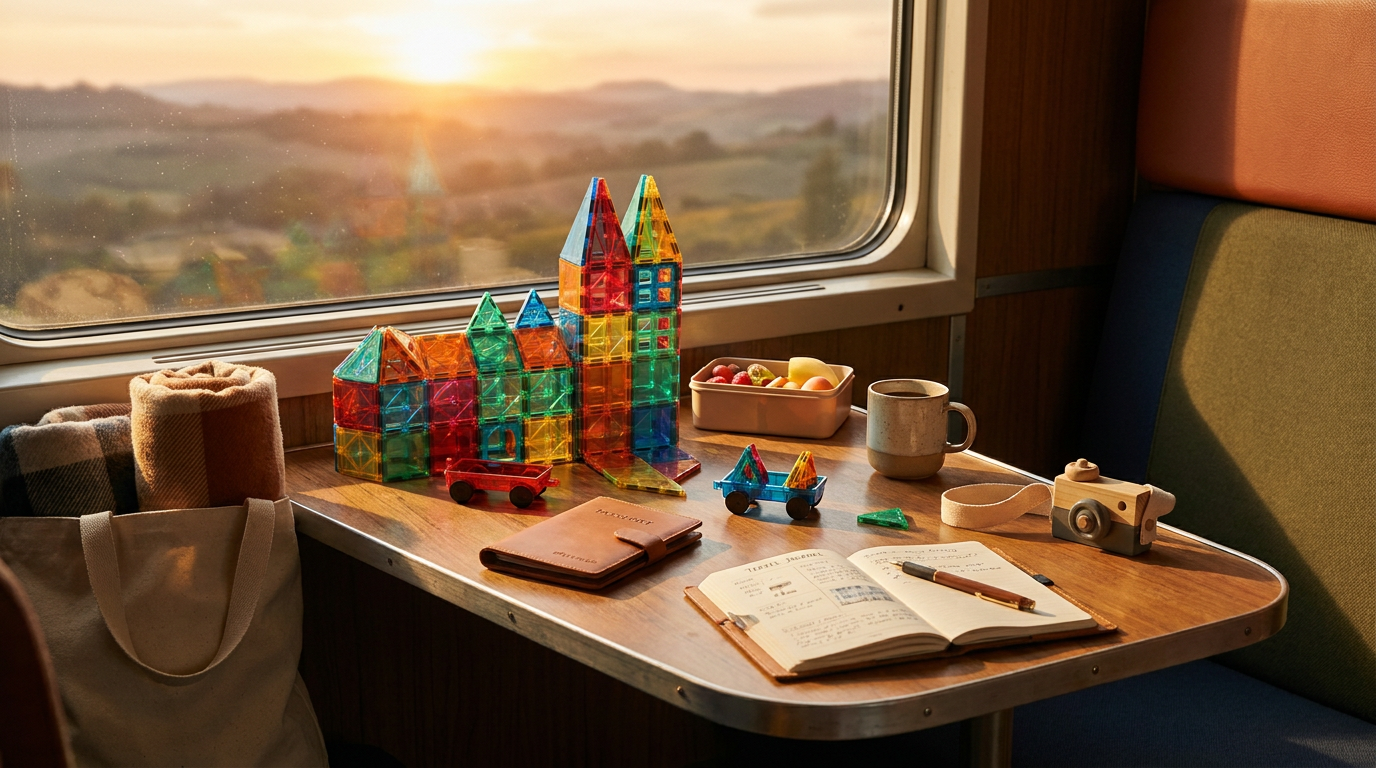
The Play-Per-Pound Ratio for Travel Magnetic Tiles
 Priya RamanSenior Analyst
Stop counting pieces; the best magnetic tiles for travel are chosen by calculating their 'Play-Per-Pound' ratio, not their magnet strength. The conventional wisdom of prioritizing piece count and magnet force fails to account for the unique constraints of travel. This framework shifts the evaluation from raw quantity to strategic efficiency, ensuring every ounce in your carry-on delivers maximum creative engagement during transit.
Why Old Metrics Fail for Travel
When selecting a toy for a trip, the primary constraints are weight and volume. A heavy set with overly strong magnets adds unnecessary pounds to your luggage—a real factor when airlines enforce strict carry-on limits, as noted by carriers like Delta Air Lines. Furthermore, an unstable airplane tray table or a lap in a moving car is not the environment for large, complex structures. Overly strong magnets do little to improve the stability of small-scale builds but significantly increase the set's weight, diminishing its travel value. The goal is not to replicate a home playroom but to deploy a lightweight, versatile tool for focused, in-transit creativity.
Calculating Play-Per-Pound
Photo by Polesie Toys on Pexels
Think of it as a matrix of Creative Versatility versus Carry-On Weight. The ideal travel set exists at the intersection of high versatility and low weight.
- Creative Versatility: This axis measures the potential for unique building combinations. A set of 50 identical squares has far less versatility than a 40-piece set containing squares, multiple triangle types, and window frames. The variety of shapes is what enables more complex and engaging building challenges with STEM Magnetic Tiles, making the set more replayable in a confined space.
- Carry-On Weight: This axis is a simple measure of the set’s total mass. The lower the weight, the higher its score as a travel companion. A lighter set is not only easier to carry but also safer for play on a small, potentially wobbly surface.
The Decision Rule for Your Next Trip
The decision rule is simple: select the lightest possible assortment that offers the most unique building combinations. A well-designed travel set maximizes the creative potential of its shapes rather than relying on the sheer number of tiles. STEM Magnetic Tiles are engineered around this principle. By focusing on a balanced assortment of foundational and specialty pieces in a durable, lightweight format, they achieve a high Play-Per-Pound ratio. This approach delivers greater value than sets that prioritize magnet strength or piece count alone, proving that the advantages of magnetic tiles vs. plastic blocks are most apparent when portability is a key factor.
Frequently Asked Questions
Photo by Polesie Toys on Pexels
How many magnetic tiles are good for travel?
Instead of a specific number, focus on the composition of the set. A curated collection of 30 to 50 pieces is typically sufficient for travel, provided it includes a versatile mix of shapes. Prioritize a set with squares, equilateral triangles, and isosceles triangles to maximize building options without adding the bulk and weight of a larger, less-varied kit.Are stronger magnets better for building in a car or plane?
Not necessarily. For the small-scale structures typically built on a tray table or lap, moderate magnet strength is perfectly adequate to maintain stability. Overly strong magnets add significant weight to each tile, which lowers the set's overall 'Play-Per-Pound' ratio. This makes the set heavier to carry without a proportional increase in in-transit playability, offering a poor return on value for portable play.