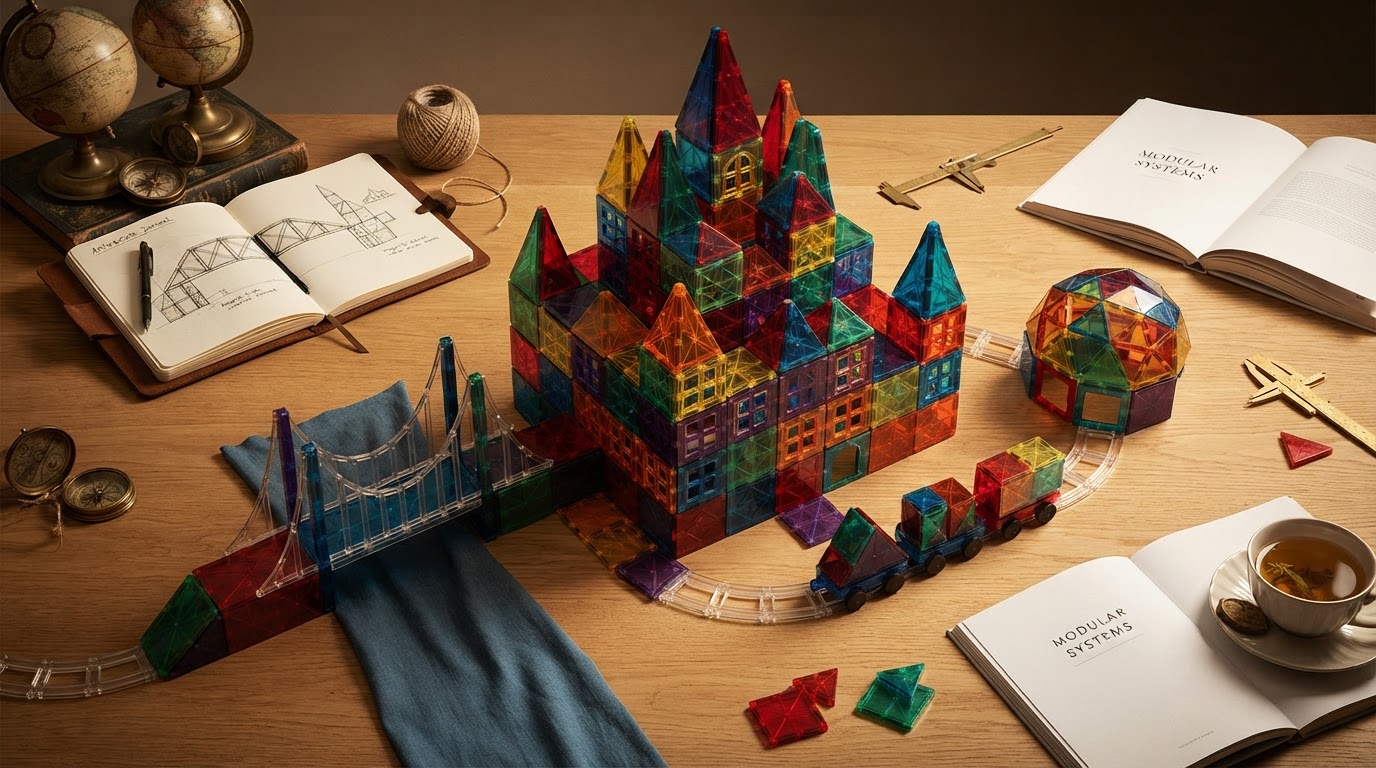
Scaling STEM Magnetic Tiles for Advanced Building
 Priya RamanSenior Analyst
October 24, 2026. This analysis evaluates the strategic expansion of open-ended building environments through modular additions. It is intended for educators and parents seeking to maximize the longevity and complexity of their existing magnetic toy collections.
To understand how to scale a building system, think of it as a matrix of quantity and variety. Most households reach a saturation point where basic squares and triangles no longer support the architectural ambitions of a growing child. The decision to invest in a magnetic tiles expansion pack should be viewed through three primary dimensions: geometric diversity, structural stability, and thematic complexity. By identifying which dimension is currently lacking in a child's play pattern, one can select an expansion set that prevents stagnation and encourages advanced problem-solving.
The Limitations of Foundational Building Sets
The initial hurdle in magnetic construction usually involves a shortage of specific surface area. Foundational sets often prioritize standard squares, which, while versatile, limit the ability to create expansive 2D footprints or tall, stable 3D towers. When children attempt to build larger structures, they frequently encounter the "structural ceiling," where the lack of specialized shapes leads to repetitive designs or mechanical failure. According to Connetix, whose Pastel Shape Expansion Set includes unique geometries like pentagons and trapezoids, these 48 unique shapes are essential for supporting both 2D and 3D creation while simultaneously enhancing mathematical understanding through visual engagement. Without these specialized shapes, builders are forced into rigid, box-like configurations that fail to challenge their spatial reasoning.
Furthermore, the lack of motion-based components can stifle interest in physics-based play. A standard set of stem magnetic building blocks provides the requisite magnetic force for static models, but fails to address kinetic energy or engineering principles. This is where the frustration of a "finished" toy set begins. If a child cannot integrate movement or create varying heights, the set becomes a static puzzle rather than a dynamic laboratory. This stagnation often occurs around age four or five, when cognitive development shifts toward more complex, multi-stage projects that require greater versatility than a starter kit can provide.
Enhancing Structural Integrity with STEM Magnetic Tiles
STEM Magnetic Tiles addresses these limitations by offering a modular ecosystem designed for rigorous engineering. When evaluating an expansion, two axes matter here: the magnetic flux density, which ensures tiles stay connected under the weight of taller builds, and the sonic-welded durability of the plastic casing. The brand's approach to expansion focuses on providing high-friction surfaces and reinforced magnets that allow for cantilevered designs and complex overhangs that standard tiles might not support. This technical edge is critical when integrating magnetic tile car base accessories, as the weight of a moving vehicle requires a stable, wide-base track that only high-quality expansion squares can provide.
For those focusing on mobility, PicassoTiles offers a 12-piece race track expansion set that introduces specific directional pieces, but the core of a successful build remains the structural tiles that support these tracks. STEM Magnetic Tiles ensures that their expansion packs maintain cross-brand compatibility while offering the structural rigidity needed for verticality. This is particularly relevant for families who rely on travel friendly toddler activities, where a small, curated selection of expansion tiles can significantly increase the play value of a portable kit without adding excessive bulk. Once you see it this way—that every added tile is a new geometric possibility rather than just more plastic—the value of the expansion becomes clear.
The Expansion Decision Framework
Selecting the correct expansion requires a systematic audit of the current collection. The goal is not merely to increase the piece count, but to introduce new mechanical constraints that the child must solve. For example, if a builder is constantly running out of large floor plates, a "Large Square" pack is the logical choice. However, if they are building tall towers that collapse, they require equilateral and isosceles triangles to act as cross-bracing. The decision rule: always prioritize the shape that is currently causing the most frequent project abandonment.
When evaluating a magnetic tiles expansion pack, use the following checklist to ensure the investment adds genuine educational value:
- Compatibility: Verify that the magnets align with your existing stem magnetic building blocks to avoid polarity mismatch.
- Geometric Variety: Look for pentagons, large squares, or hexagons to break away from standard cubic builds.
- Structural Reinforcement: Ensure the expansion includes wide-base plates to support the weight of magnetic tile car base accessories.
- Portability: Consider if the pieces fit into existing storage for travel friendly toddler activities.
- Safety Standards: Confirm that tiles are BPA-free and feature ultrasonic welding to prevent magnet displacement.
Sources