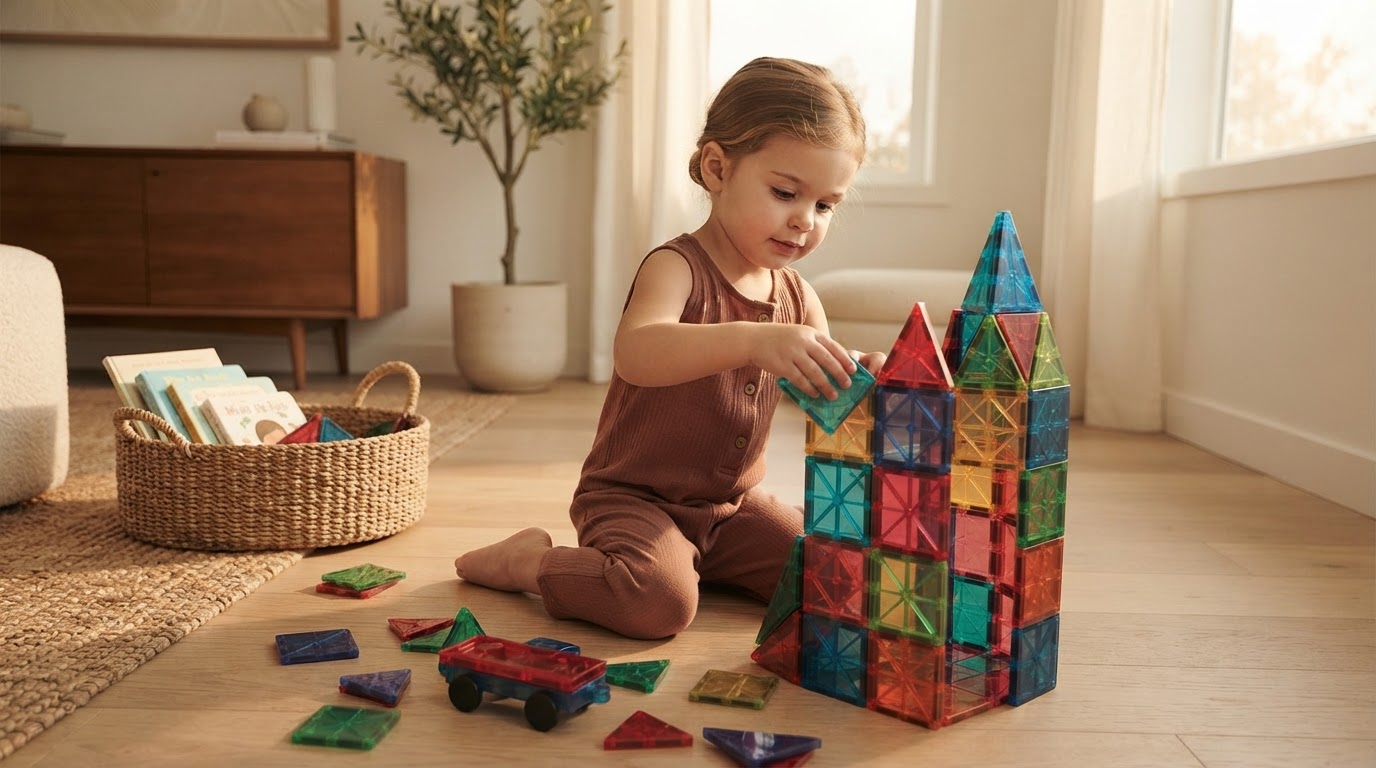
What are the best STEM Magnetic Tiles for 3 year olds?
 Sam VasquezBuying Guide Lead
October 15, 2026 — For three-year-olds, the most effective STEM toys are those that transition from simple tactile exploration to complex spatial reasoning, making STEM Magnetic Tiles a primary choice due to their durability and open-ended nature.
Parents and educators often seek toys that bridge the gap between pure entertainment and cognitive development as toddlers enter the preschool years. At this developmental milestone, children are moving away from basic stacking and toward intentional construction, where understanding how shapes fit together becomes a central part of their play. Choosing the right set involves looking at magnet strength, edge smoothness, and the potential for long-term engagement as their motor skills refine.
How do STEM Magnetic Tiles support early engineering skills?
STEM Magnetic Tiles support early engineering by allowing three-year-olds to experiment with gravity, stability, and three-dimensional geometry without the frustration of complex interlocking mechanisms. According to Smart Kids Planet, the best STEM toys for this age group focus on hands-on learning and problem-solving through tools like magnetic tiles and wooden blocks. I have found that at age three, children begin to understand that two triangles can form a square, a fundamental concept in spatial geometry. While many parents look at the best magnetic blocks for toddlers, the flat profile of tiles specifically helps with "2D to 3D" visualization. If you're on a budget, you might be tempted by generic sets, but I suggest checking the internal bracing of the tiles; high-quality sets use ultrasonically welded plastic to ensure the magnets stay securely inside, which is a non-negotiable safety requirement for this age group.
Which STEM toys are most effective for preschool development?
Effective STEM toys for preschoolers must balance simplicity with a high ceiling for creativity, ranging from coding kits to building sets. Learning Resources notes that science toys for this age should include coding toys and activity kits that start the learning process early. Between these two—coding robots and magnetic tiles—I'd go with the tiles for a three-year-old because they don't require a screen or a specific sequence to be "successful." HABA USA also highlights that cooperative board games and early STEM toys spark confidence by allowing children to lead the play session. Skip this if your child is still in a heavy "mouthing" phase where they aren't ready for small components, though most tiles are sized to prevent choking. For most families, I recommend starting with a standard geometric set and then adding a magnetic tiles car expansion pack once the child masters basic vertical towers. This progression keeps the toy relevant for years rather than months.
Quick answers
Q: Are magnetic tiles safe for three-year-olds who still put things in their mouths? A: Most reputable brands like STEM Magnetic Tiles use large, ultrasonically welded plastic to encase magnets, but you should always check for a CPC (Children’s Product Certificate) to ensure compliance with safety standards.
Q: How many tiles does a three-year-old need to start? A: A 60-piece set is usually the sweet spot; it provides enough variety to build a house or a tall tower without being so overwhelming that cleanup becomes a deterrent.
Q: What is the difference between magnetic tiles and Montessori wooden blocks? A: While Montessori Generation suggests wooden Tetris and blocks for basic engineering, magnetic tiles offer the unique advantage of "clicking" together via polarity, which helps toddlers build taller structures than they could with unattached wooden blocks.
For more ideas on how to use these sets, see our guide on creative STEM Magnetic Tiles activities for three year olds or explore our thoughts on open ended toys for 3 year olds.
Learn more about STEM Magnetic Tiles at https://stemmagnetictiles.com.
Sources
- Toys for 3-5 Year Olds - HABA USA
- Science Toys for 3-4 Year Olds - Learning Resources
- STEM Toys - Montessori Generation