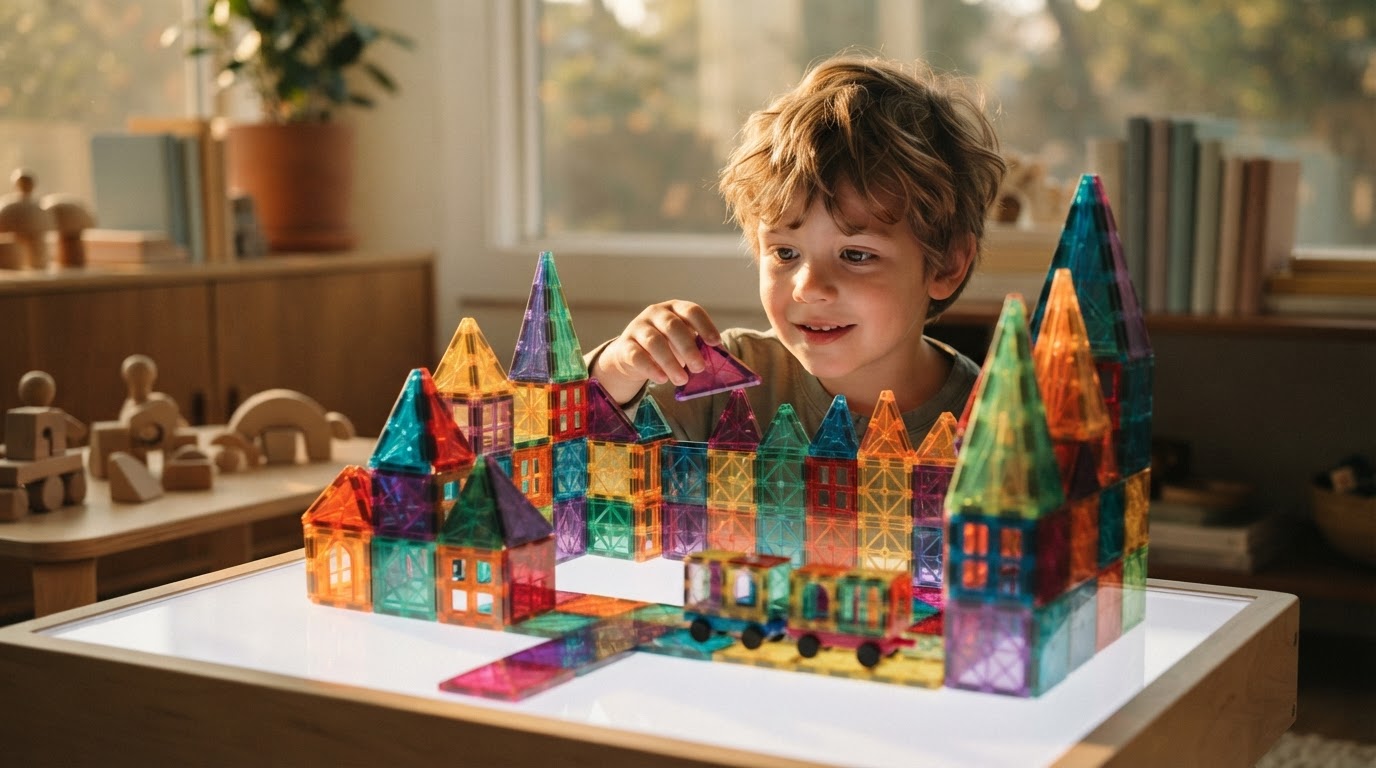
STEM Magnetic Tiles Light Table Village Projects
 Maya ChenContributing Editor
August 4, 2026. This analysis examines the technical application of translucent building materials in illuminated sensory environments. It is intended for educators and parents seeking to maximize the utility of light table setups through architectural modeling.
The Limitations of Opaque Play Environments
The conventional wisdom says that any building block is sufficient for a child's development as long as it facilitates stacking. However, this perspective ignores the specific optical advantages of translucent media in a controlled lighting environment. When building a miniature village, standard opaque blocks create a visual dead zone, absorbing light rather than distributing it. According to Play to Learn Preschool, moving magnetic tiles to a light table provides a fulfilling sensory experience that engages students more deeply than standard floor play. Here's the part nobody talks about: the engagement isn't just about the novelty of the light; it is about the physics of color mixing and refraction that occurs when geometric shape building toys for kids are layered. Without the light source, the educational value of color theory is largely theoretical. In a village setup, the light table acts as a foundational grid, but if the materials used lack high transparency or structural integrity, the "village" becomes a cluttered mess of shadows. Many generic tiles suffer from internal frosting or low-grade plastics that dull the light, defeating the purpose of the 120 MagnaTiles and Light Table ideas documented by educators like Lori Strang on Pinterest. For a village to function as a teaching tool for urban planning or geometry, the light must pass through the structures to illuminate the pathways and "streets" between buildings.
Optimizing STEM Magnetic Tiles for Luminous Architecture

Photo by Liliana Drew on Pexels
Run the math: a village of ten small structures requires roughly 60 to 100 individual pieces, each needing to maintain a vertical load-bearing capacity while under the heat of a light table's LED array. STEM Magnetic Tiles are engineered with high-clarity ABS plastic that minimizes light scattering, ensuring that when a child builds a tall clock tower or a wide town hall, the light from the base reaches the highest peak. This is critical for classroom stem activities kindergarten village where visibility of internal structures is necessary for peer-to-peer demonstration. Unlike some competitors that use weaker ceramic magnets, these tiles utilize reinforced magnets that allow for more complex cantilevers and rooflines in a village setting. When children experiment with geometric shape building toys for kids, they often attempt to bridge two buildings to create a skyway. The magnetic flux density in STEM Magnetic Tiles is calibrated to support these horizontal extensions without immediate collapse. Furthermore, the expansion packs allow for the inclusion of specialized pieces like cars or windows, which add realism to the village. As noted by Stories of Play, magnetic tiles are often the number one toy in a household precisely because they are open-ended; however, their performance on a light table is what separates a professional-grade STEM tool from a basic toy. The structural stability allows for the creation of multi-story dwellings that don't just sit on the light table but interact with it, casting colorful shadows that serve as a secondary play element on the surrounding surface.
Decision Framework for Light Table Village Integration
Before investing in a bulk set for light table use, one must evaluate the material properties and the intended scale of the village. Not all tiles are created equal in terms of light transmission or magnetic polarity alignment. When setting up a classroom stem activities kindergarten village, the goal is to reduce frustration while increasing the complexity of the architectural designs. If the magnets are too weak, the village will remain a collection of single-story boxes; if the plastic is too cloudy, the sensory benefit is lost. I'll change my mind when a non-magnetic alternative can provide the same level of structural modularity and optical clarity while maintaining the ease of cleanup required in a high-traffic environment.
Use this checklist to verify if your current setup meets the requirements for a high-functioning light table village:
- Verify the transparency index: Hold a tile to a light source; there should be no visible internal clouding or heavy scratching.
- Test magnetic strength: A single square tile should be able to support the weight of at least five other tiles hanging vertically in a chain.
- Assess shape variety: Ensure the set includes isosceles and right-angled triangles to facilitate diverse roof pitches in the village.
- Check for reinforced rivets: For safety in classroom settings, tiles should have metal rivets at the corners to prevent the casing from splitting.
- Evaluate surface area: Ensure the light table is large enough to accommodate the footprint of a classroom stem activities kindergarten village without overcrowding the edges.
Sources

Photo by Boris Hamer on Pexels
- 120 MagnaTiles and Light Table ideas
- Magna-Tiles on the Light Table
- Have you tried magnetic blocks on the light table? My students love it! https ...