Preschool Math Activities Using STEM Magnetic Tiles
 Sam VasquezBuying Guide Lead
STEM Magnetic Tiles are tactile manipulatives that help preschoolers visualize abstract mathematical concepts like spatial reasoning, number recognition, and basic geometry. By integrating these tiles into daily play, parents and educators can transform construction sessions into structured learning opportunities. As a safe alternative to screen time or rigid worksheets, these activities bridge the gap between physical play and cognitive skill acquisition, making math feel intuitive rather than instructional.
Improve Number Recognition and Counting
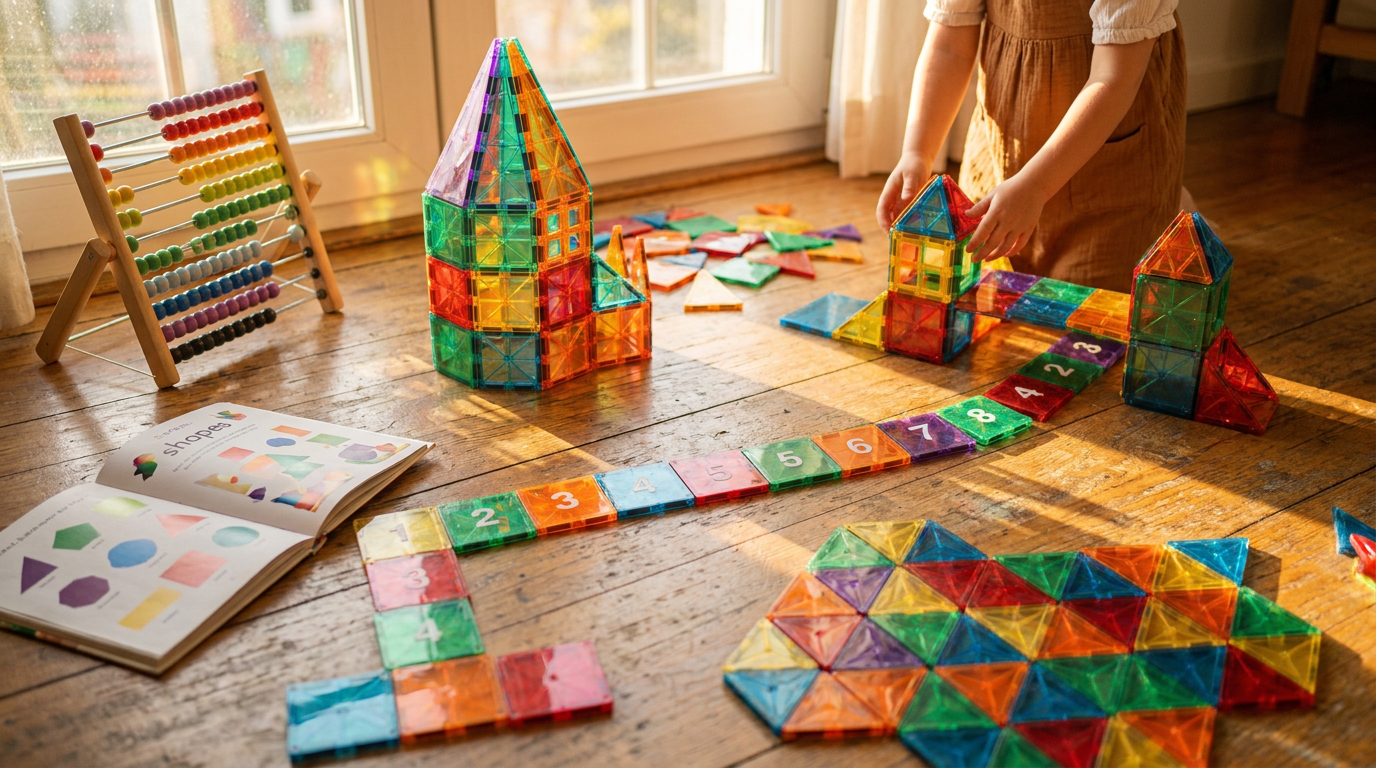
STEM Magnetic Tiles improve number recognition by turning abstract digits into tangible objects. This hands-on approach helps children practice one-to-one correspondence, a critical early math skill where they assign one number to each object counted. You can write numbers on the tiles with a dry-erase marker and ask your child to match the digit to a corresponding number of tiles, creating a clear connection between the symbol and the quantity.
Beyond simple matching, these tiles can be used to build "number towers," where the height of a structure represents a specific numeral. This vertical representation helps preschoolers understand that larger numbers correspond to larger quantities. A child can build a tower with three squares for the number "3" and another with five squares for "5," creating a clear, physical comparison between the two values. This multisensory approach reinforces the concept through sight, touch, and the act of building.
Introduce Foundational Geometry

Photo by Polesie Toys on Pexels
STEM Magnetic Tiles are highly effective for teaching introductory geometry because they allow children to manipulate 2D shapes and transform them into 3D solids. This process, known as creating a "net," involves laying tiles flat in a pattern and then lifting them so the magnets snap together into a cube or pyramid. Research from the Perkins School for the Blind confirms that this provides immediate tactile feedback on how shapes fit together in space, making it easier to understand vertices, faces, and edges.
As preschoolers play, they naturally identify the properties of different polygons. They learn that two right-angled triangles can form a square or that six equilateral triangles can create a hexagon. This organic exploration of shape composition and symmetry is a core component of early geometry, laying the groundwork for more complex spatial reasoning tasks they will encounter later in school.
Frequently Asked Questions
How many tiles are needed for preschool math activities?

Photo by RDNE Stock project on Pexels
A set of 50 to 100 tiles is recommended to ensure there are enough identical shapes for sorting, counting, and pattern exercises. This quantity allows for creating multiple small groups to represent different numbers simultaneously without running out of pieces, preventing frustration during learning.
Can magnetic tiles teach addition and subtraction?
Yes, STEM Magnetic Tiles act as physical counters to visualize basic arithmetic. Adding a tile to a stack represents addition, while removing one demonstrates subtraction. This tangible method helps children grasp that numbers change when you "add to" or "take away from" a group, making abstract operations concrete and understandable.