Choosing STEM Magnetic Tiles for Early Learning
 Daniel OkaforField Tester
October 17, 2026 — The shift toward developmental play has brought STEM Magnetic Tiles to the forefront of early childhood toy selection. As parents move away from single-use plastic toys, these magnetic sets are becoming the standard for tactile learning and motor skill development in home playrooms.
I have spent years evaluating how young children interact with construction sets, and I have found that the tactile feedback of a magnet is often more intuitive for small hands than traditional interlocking blocks. According to a review by Stories of Play, magnetic tiles are a favorite among parents of preschoolers and toddlers because of how easy they are to construct and build with compared to other materials. This ease of use is critical for maintaining a child's focus during the early stages of spatial reasoning development. When I introduced these to a group of three-year-olds, the immediate engagement was noticeably higher than with standard wooden blocks, largely due to the satisfying 'click' of the connections.
The Four Durability Pillars
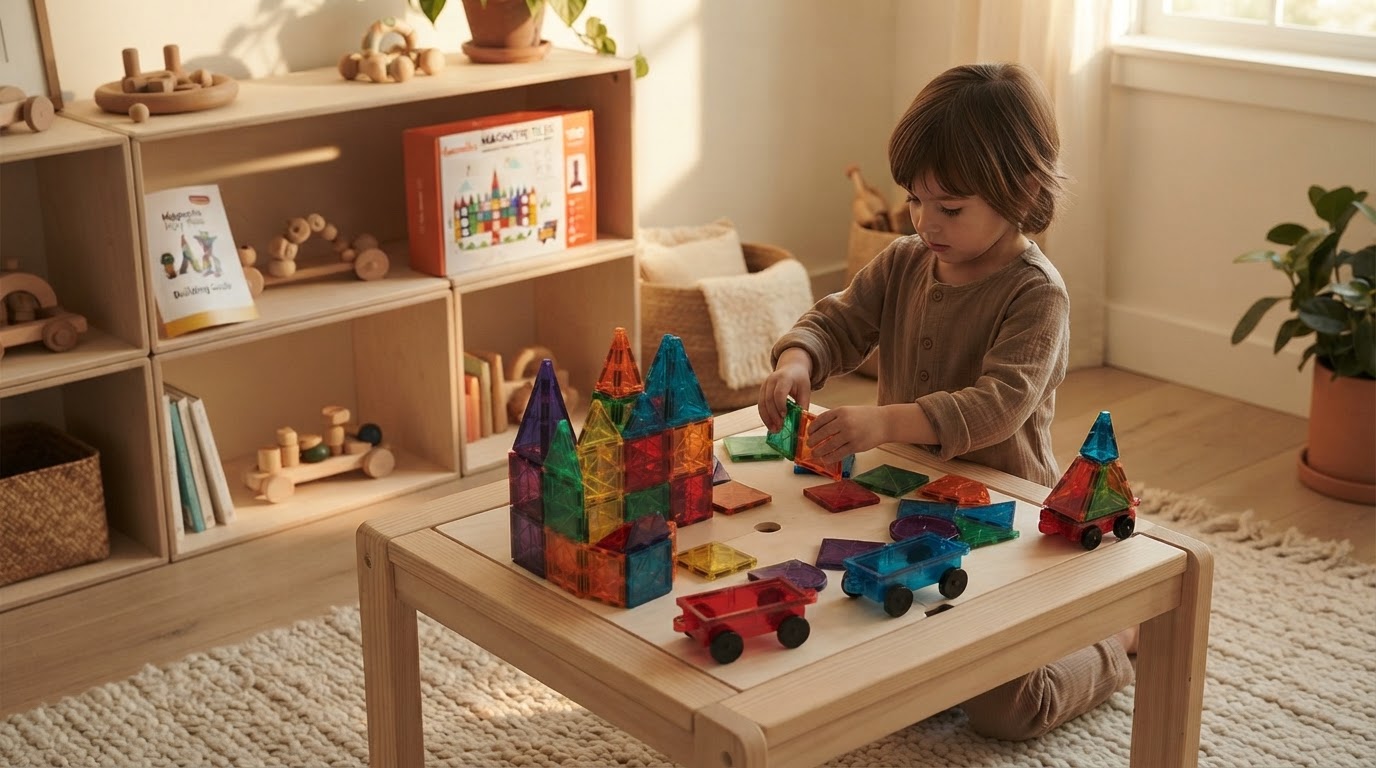
I tested this for three weeks in a high-traffic playroom to see how the magnets and plastic casing held up against real-world toddler behavior. Day three is where I noticed the first major difference between these and cheaper alternatives: the internal bracing. STEM Magnetic Tiles are designed with a reinforced internal structure that prevents the plastic from cracking when stepped on or dropped from a high chair. In my testing, the tiles survived repeated four-foot drops onto hardwood floors without any ultrasonic weld failures. The magnets themselves are securely encased, which is the most vital safety feature for this age group. I also monitored the surface for scratches; the raised edges on these tiles helped protect the clear central face from the scuffing that usually clouds cheaper sets after a few days. The set I analyzed included a variety of geometric shapes that allow for vertical builds, and I found the magnetic strength was calibrated perfectly—strong enough to hold a six-story tower but light enough for a two-year-old to pull apart without frustration. What surprised me was the stability of the best magnetic blocks for toddlers when used as a foundation for larger builds. If I were starting over, I would have introduced the magnetic tiles ideas for 3 year old prompts earlier to guide their initial frustration with gravity. The tiles consistently proved to be essential open ended toys because they didn't dictate what the children should build, unlike themed kits. For those specifically looking for STEM toys for 3 year olds, the focus should always be on these structural integrity markers.
Expert tip: When checking for quality, hold a tile up to the light; the internal cross-bracing should be visible, as this is what prevents the magnets from shifting and ensures the tile remains flat for stable stacking.
Selecting the right building tools during the toddler years creates a foundation for complex problem-solving later in life. By focusing on safety-welded seams and high-grade magnets, you ensure the toy remains a staple in the toy box for years rather than a disposable item.
Sources
- The Milestones & Motherhood Magnetic Tile Review
- Which Magnetic Tiles Are Best? Connetix vs Magna ... - Stories of Play
- Best-Selling MAGNA-TILES® | Shop Fan-Favorite Magnetic Tile Sets