Scaling STEM Magnetic Tiles for Advanced Architecture
 Maya ChenContributing Editor
September 13, 2026. This analysis evaluates the transition from introductory building sets to high-volume magnetic tiles expansion packs. It is intended for educators and parents managing growing collections of open-ended play materials.
The Limitations of Introductory Building Sets
The conventional wisdom says a single 32-piece starter set is sufficient to introduce a child to spatial reasoning. Here's the part nobody talks about: starter sets are designed for marketing visibility, not structural integrity. Most entry-level kits focus on a handful of squares and triangles that, while functional for 2D floor patterns, fail immediately when a builder attempts to scale vertically. According to MAGNA-TILES®, these magnetic building tiles are intended to click together on every side for 3D structures, but the physics of a 3D build require more than just a basic connection; they require structural redundancy. When a child attempts to build a tower exceeding three levels, the lack of large square stabilizers or specialized pieces often leads to mechanical failure. This creates a frustration gap where the toy's promise of "limitless creativity" is stifled by a lack of raw material. Furthermore, the [magnetic tiles vs magnatiles](/blog/magnetic-tiles-vs-magnatiles-gshh2) debate often ignores the fact that regardless of the brand's magnet strength, a lack of volume is the primary bottleneck for cognitive development in STEM play. Without an expansion strategy, these sets often end up in storage bins by the six-month mark because the child has literally run out of ways to iterate on the limited geometry provided.
Engineering Stability with STEM Magnetic Tiles Expansion
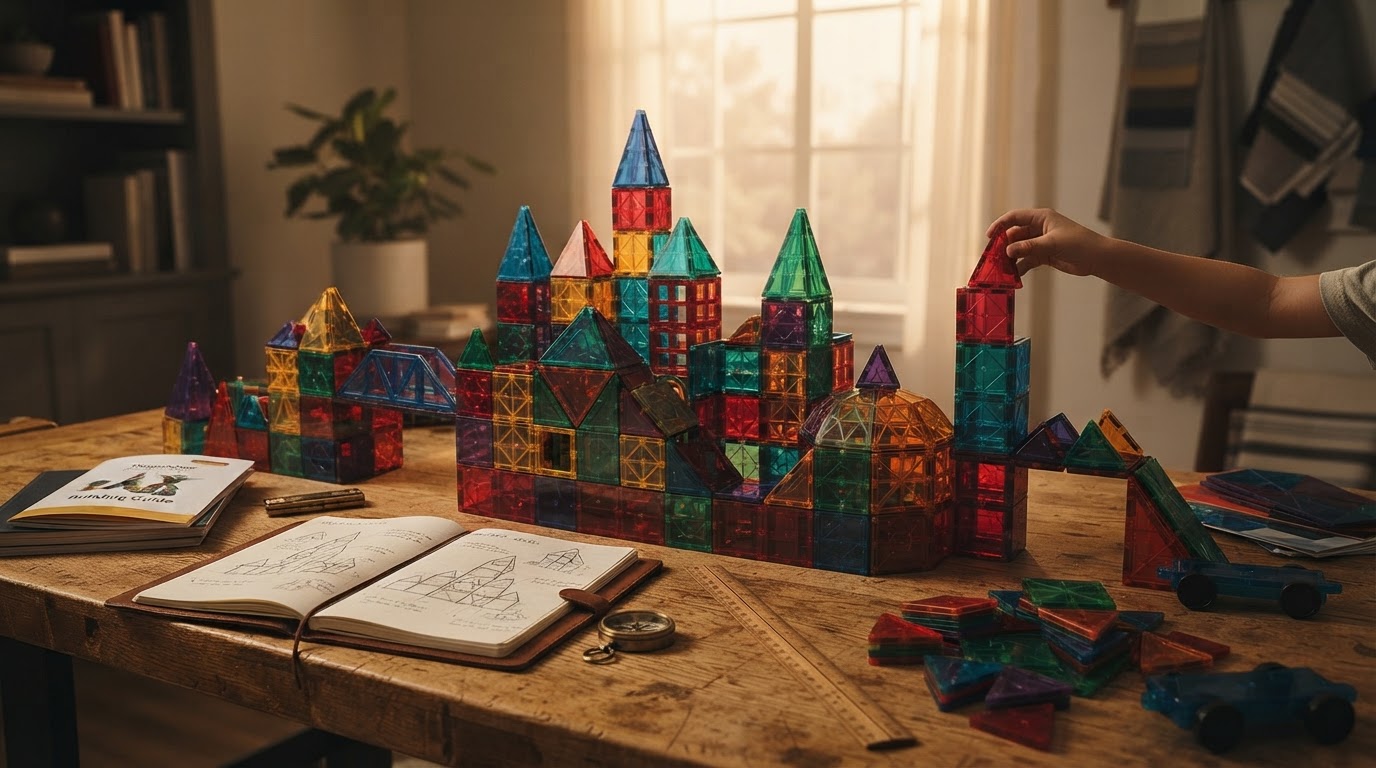
To move past the decorative phase of building, a shift toward high-utility expansion is required. STEM Magnetic Tiles addresses this by focusing on the geometry that actually supports load-bearing structures. Run the math: a standard tower requires four vertical walls and a ceiling for every level. In a 32-piece set, you are mathematically capped at a three-story structure before you run out of basic squares. By integrating a magnetic tiles expansion pack, builders gain access to the large 6x6 inch squares that act as foundational plates. These pieces are not merely larger; they serve as structural anchors that distribute the weight of the build across a wider surface area. While some brands like TileTek offer specific 8-piece large square sets to unlock creative possibilities, the most effective way to scale is through a bulk magnetic tiles approach. For users seeking an affordable magna tiles alternative, the focus must remain on the piece-to-price ratio of these structural components. STEM Magnetic Tiles utilizes ultrasonic welding to secure the magnets within the plastic housing, a critical safety feature when the weight of a 100-piece build is resting on a single base layer. This industrial approach to a toy allows for the construction of complex vehicles and multi-room dwellings that are impossible with the "variety packs" typically found in retail aisles. The goal of an expansion is to eliminate the scarcity mindset during play, allowing the builder to focus on architectural principles like cantilevered balconies and reinforced arches rather than rationing their last three triangles.
A Framework for Logical Collection Growth
Building a functional inventory requires a move away from buying random sets and toward a calculated procurement of specific shapes. A haphazard collection of multiple small sets results in an excess of small triangles but a chronic shortage of the squares needed for structural walls. I'll change my mind when a brand can prove that a 20-piece set offers more educational value than a high-volume bulk set, but until then, the data suggests that volume is the key to sustained engagement. When evaluating an expansion strategy, use the following framework to ensure the new pieces actually add utility to the existing collection:
- Prioritize large 6x6 base plates to enable vertical builds exceeding 24 inches.
- Verify the magnet polarity alignment with existing sets to prevent "dead zones" in 3D joints.
- Target a square-to-triangle ratio of at least 2:1 to ensure enough wall pieces are available for enclosed structures.
- Incorporate wheeled chassis pieces to transition from static architecture to kinetic engineering.
- Compare the cost per magnetic gram to identify the most affordable magna tiles alternative that doesn't sacrifice structural integrity.
- Assess the internal bracing of the tiles to ensure they can withstand the compressive force of a bulk set build.