STEM Magnetic Tiles Kindergarten Village Framework
 Daniel OkaforField Tester
August 5, 2026 — Educators are increasingly adopting STEM Magnetic Tiles to facilitate collaborative engineering projects in early childhood settings.
I spent the last week observing how five-year-olds interact with structural challenges, and the results confirmed that building a miniature community is one of the most effective ways to introduce complex concepts. According to resources from Newport School, building and engineering challenges are among the top 5 STEM activities to help with early childhood education, specifically by fostering problem-solving and fine motor skills. When children work together to create a cohesive village, they transition from solitary play to a shared engineering goal, which is essential for the kindergarten curriculum.
The Three-Zone Village Blueprint

Photo by RDNE Stock project on Pexels
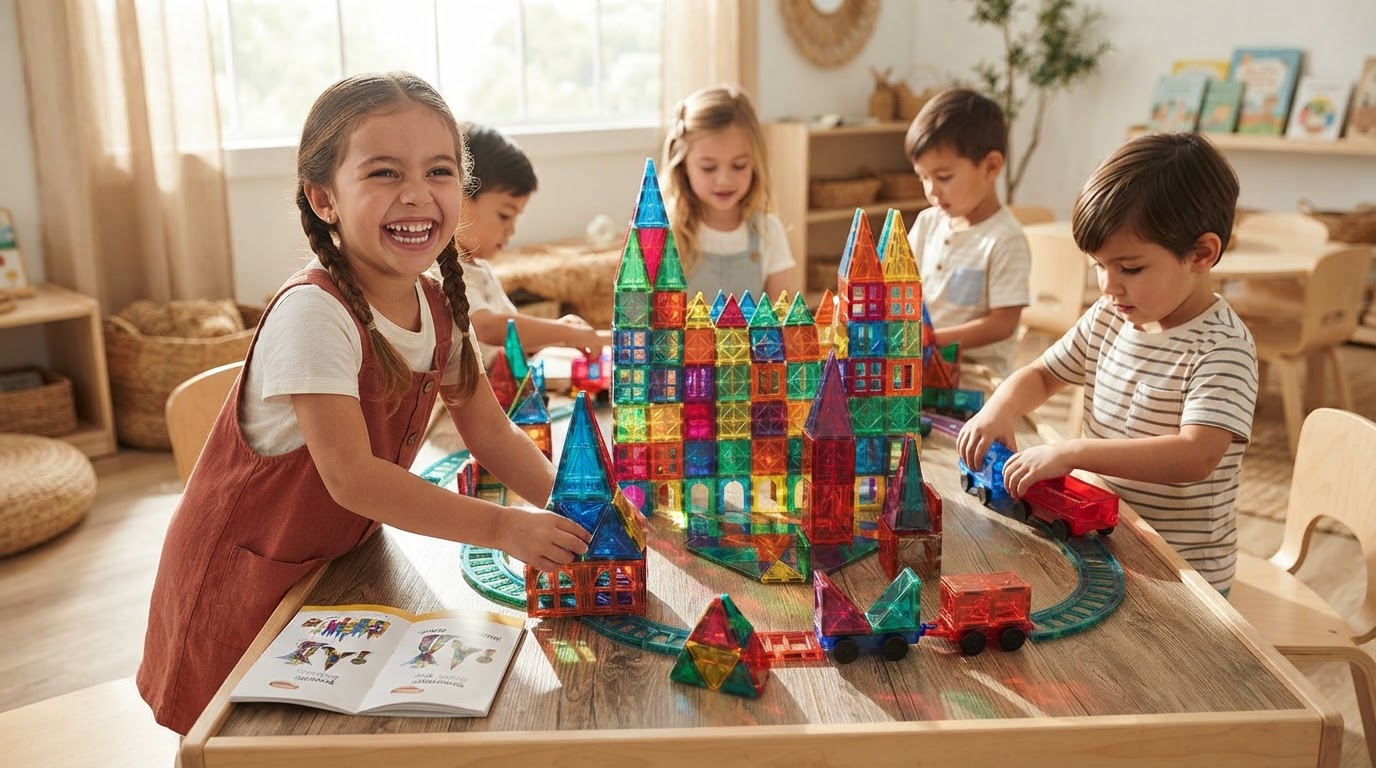
I tested this for a full school week to see how the structures held up under heavy classroom use. Day three is where I noticed the students moving beyond simple towers and starting to think about urban planning. To make this work in a 20-minute block, I divided the tiles into three distinct zones: residential, commercial, and infrastructure. In the residential zone, I encouraged the use of geometric shape building toys for kids to create varied rooflines, while the commercial zone focused on taller, reinforced structures. What surprised me was how the magnets handled the 'bridge' connections between zones; the internal bracing in these tiles allowed for spans of up to three square units without collapsing under their own weight. For classrooms with specialized lighting setups, integrating magnetic tiles light table activities village projects can add a layer of visual interest that keeps engagement high during afternoon sessions. I found that using the car expansion packs for the infrastructure zone provided the necessary mobility to link the different sections of the village together. If I were to do this differently next time, I would prep pre-sorted bins for each zone to reduce the initial sorting time. The durability of these tiles is significant for high-traffic environments, as they frequently survived drops from desk height onto hard classroom flooring without cracking or losing magnet alignment.
Expert tip: When students are building tall 'skyscrapers' for their village, have them use the large square tiles as a foundation base to lower the center of gravity and prevent the structure from tipping during the building process.
Developing a village helps children understand how different parts of a system work together, much like the components of geometric shape building toys for kids form a larger whole. For teachers looking to expand their curriculum, these magnetic tiles light table activities village ideas offer a great way to rotate through different sensory experiences while maintaining the same core building set.