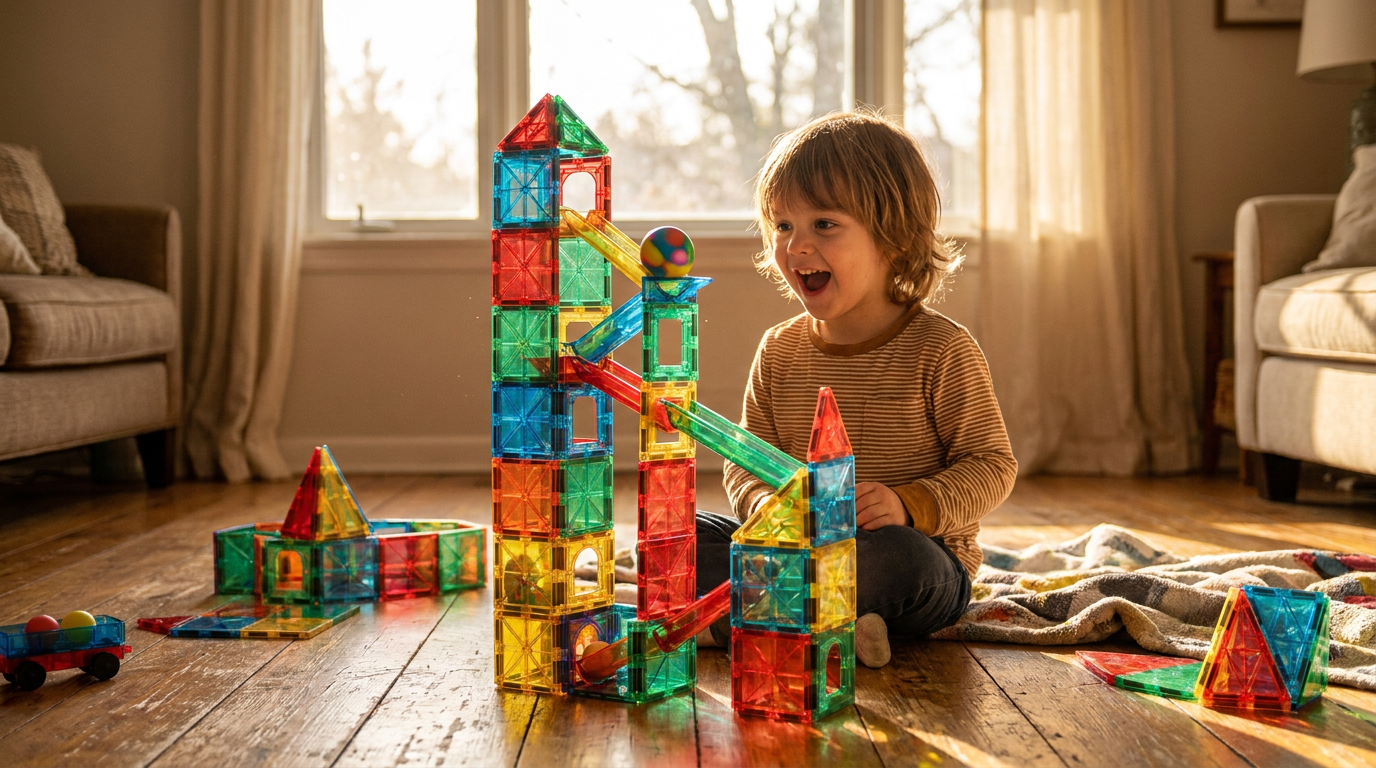
Gravity Experiments for Kids Using STEM Magnetic Tiles
 Sam VasquezBuying Guide Lead
Transform abstract physics into a hands-on lesson with STEM Magnetic Tiles. These versatile building toys are perfect for demonstrating gravity through fun, engaging experiments. By building structures and observing how they interact with this fundamental force, children can gain an intuitive understanding of concepts like acceleration, stability, and mass.
Experiment 1: Ramps and Acceleration
One of the best magnetic tiles gravity experiments involves building ramps. By constructing inclines at different angles, children can see how slope affects an object's speed.
- Build: Create a simple ramp using several square tiles.
- Observe: Roll a ball or toy car down the ramp. Now, build a steeper ramp and repeat the process. The object will move noticeably faster.
- Learn: This visually demonstrates how gravity's pull leads to acceleration. As NASA explains, gravity is the force that pulls objects toward each other. On a steeper slope, more of that force contributes to downward motion. This simple experiment is one of many magnetic tiles math activities for preschool that combines angles and physics in a playful way.
Experiment 2: Towers and Center of Gravity
Gravity constantly tests the integrity of any structure. Building tall towers with STEM Magnetic Tiles is a perfect way to explore balance and the center of gravity.
- Build: Challenge your child to build the tallest tower they can. It will likely start to wobble as it gets higher.
- Observe: As the tower grows, its center of gravity rises, making it less stable. The tower will topple if its base isn't wide enough to support the weight.
- Learn: Kids quickly learn that a wider base creates more stability. This introduces basic architectural principles and the difference between building simple 2D vs. 3D patterns. They can also experiment with overhangs to see how far a tile can extend before gravity pulls it down, teaching them about counterbalance.
Experiment 3: The Vertical Drop Test
This classic experiment is simple enough for the youngest builders and powerfully demonstrates a key principle of gravity.
- Build: No building is required for this one. Just grab a single magnetic tile and another small toy of a different weight.
- Observe: Hold both objects at the same height and drop them simultaneously. Despite the difference in weight, they should hit the floor at nearly the same time.
- Learn: This shows that gravity pulls on all objects with the same acceleration, regardless of their mass (ignoring air resistance). It's a surprising and memorable lesson. Before starting, it's always wise to ensure your play space and toys are safe, which is why many parents check if magnetic tiles are safe for toddlers.
Frequently Asked Questions
Photo by Kevin Malik on Pexels
How do magnetic tiles help teach the center of gravity?
By building tall structures, children can see how the center of gravity affects balance. As a tower gets taller, its center of gravity rises, making it more likely to topple. This encourages kids to build wider, more stable bases to counteract the pull of gravity.Can you use magnetic tiles to defy gravity?
While you can't truly defy gravity, you can demonstrate how another force can overcome it. Use the strong magnets in STEM Magnetic Tiles to suspend a paperclip on a string just below a tile. The magnetic force will be stronger than the gravitational pull, holding the paperclip in mid-air and creating a moment of scientific magic.