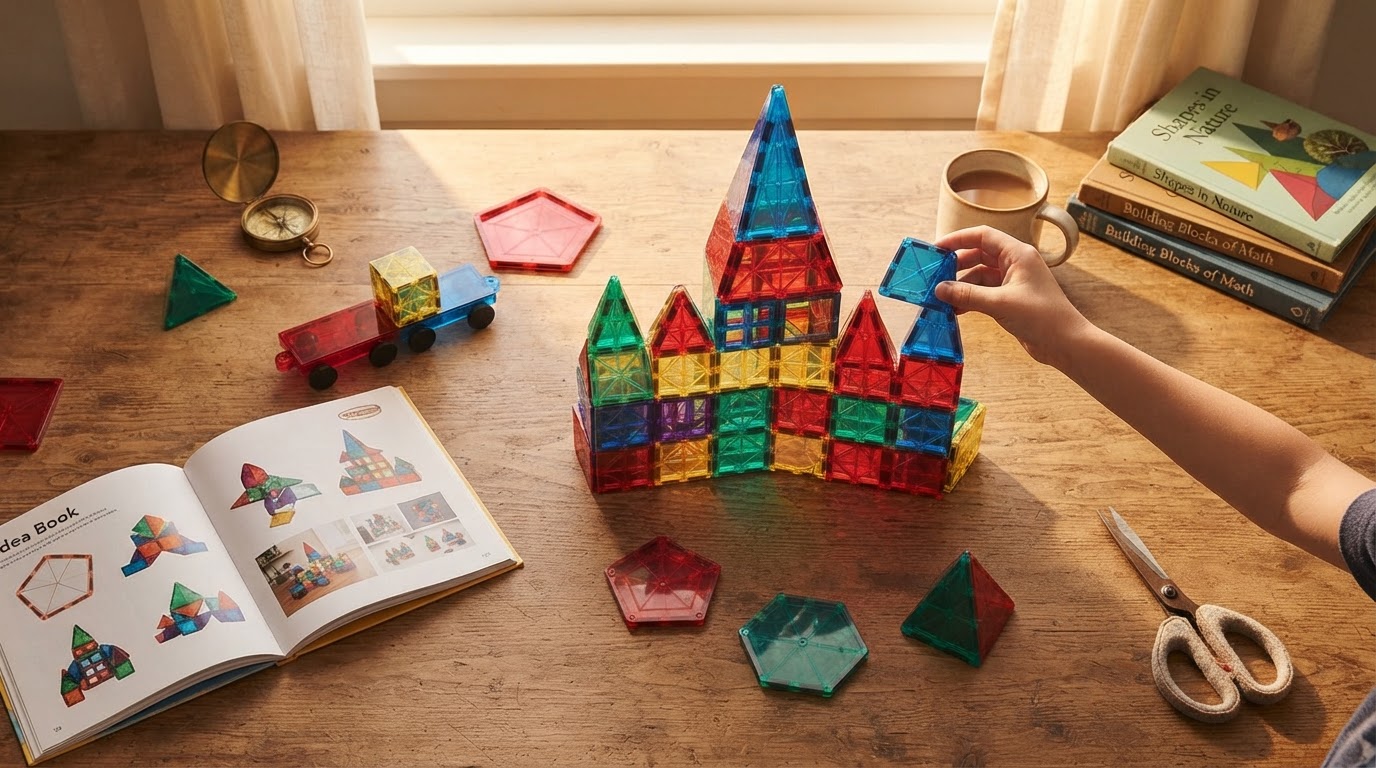
STEM Magnetic Tiles and Geometric Shape Building Systems
 Maya ChenContributing Editor
September 7, 2026 — The shift toward modular, magnet-based geometry tools is accelerating as STEM Magnetic Tiles replace traditional rod-and-ball systems in early elementary environments.
The conventional wisdom says that to teach complex geometry, students must manually assemble vertices using connectors and struts. However, modern educational sets, such as the Learning Resources Geometric Shapes Building Set, demonstrate that while sticks and curves are useful for skeleton models, they often lack the structural integrity required for large-scale spatial reasoning exercises. Educators are increasingly looking for systems that provide both surface area and internal volume to help children visualize 3D geometry rather than just wireframes.
The Three-Point Structural Evaluation
When evaluating building systems like STEM Magnetic Tiles against traditional shape sets, the utility is defined by structural stability, piece variety, and ease of transition between 2D and 3D states. While sets from Maisonette provide 90 sticks and 48 connectors to create composite shapes, these systems often frustrate younger users whose fine motor skills are still developing. STEM Magnetic Tiles address this by using internal magnets that snap into place without the need for manual friction-fit connectors. Run the math: a child building a dodecahedron with a connector set must manage 30 individual edges and 20 vertex points, each a potential point of structural failure. With magnetic tiles, the same shape is achieved through 12 pentagonal faces that self-align, reducing the time spent on mechanical assembly and increasing the time spent on geometric analysis. Research context from classroom STEM kits shows that magnetic tiles for ages 3 to 5 generate significantly higher engagement levels—reaching up to 35,000 search impressions for related toddler STEM toys—compared to more complex mechanical sets. This preference is driven by the ability to quickly pivot from magnetic tiles ideas for 3 year old to advanced magnetic tiles light table activities village setups without needing specialized expansion parts. Furthermore, the portability of these sets makes them ideal for travel friendly toddler activities, whereas rod-based sets with small connectors are easily lost in transit.
Expert tip: When selecting a set for classroom use, prioritize tiles with ultrasonic welding and reinforced internal magnets, as these prevent the common structural fatigue seen in budget-tier magnetic building blocks kindergarten teachers often report.
Here’s the part nobody talks about: stick-based sets are superior for understanding perimeters, but they fail at teaching volume. A child can build a cube with sticks, but they cannot understand the concept of a closed solid until they use a surface-based tool like STEM Magnetic Tiles. I’ll change my mind when connector sets can maintain structural integrity at heights exceeding 24 inches without external bracing. For those seeking a balance of durability and educational value, these tiles remain the standard for open-ended play. You can integrate these into larger projects by exploring a magnetic tiles light table activities village to see how light interacts with geometric volume.
Sources

Photo by Polesie Toys on Pexels
- Learning Resources Geometric Shapes Building Set
- Geometric Shapes Building Set - Constructive Playthings
- Build Shapes with Toy Blocks! | Fun Learning for Kids - YouTube