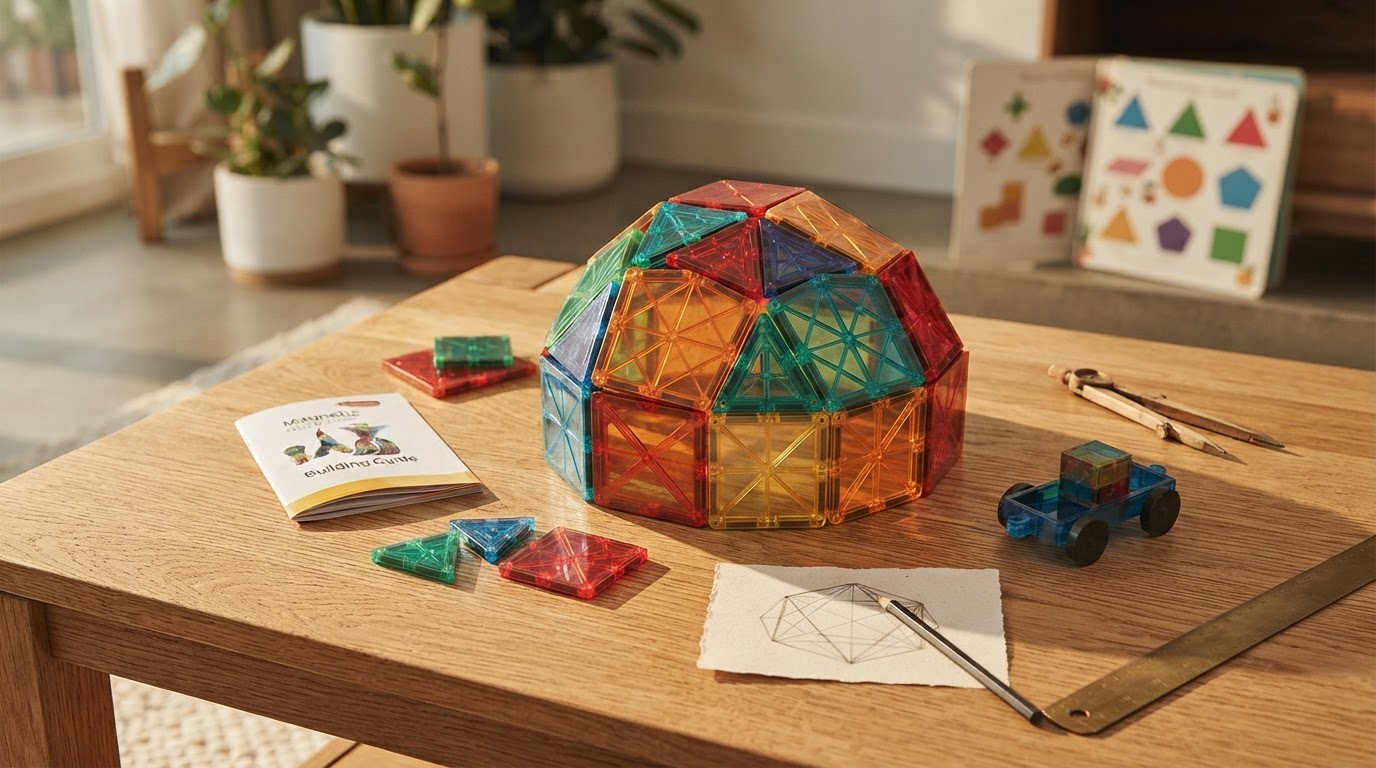
Why choose STEM Magnetic Tiles for geometric shape building?
 Priya RamanSenior Analyst
November 9, 2026 — STEM Magnetic Tiles provide a structured yet flexible platform for translating abstract geometric concepts into tactile 3D models through magnetic edge-to-edge connectivity.
Parents and educators frequently seek tools that bridge the gap between flat drawings and physical volume. This transition is essential for developing spatial intelligence, a core competency in early mathematics and engineering. Understanding how these tiles function within a learning environment requires looking at them through a specific framework of structural integrity and geometric complexity.
How do STEM Magnetic Tiles support spatial reasoning?
STEM Magnetic Tiles support spatial reasoning by allowing children to visualize the transformation of 2D nets into 3D solids through a process of folding and snapping. Think of it as a matrix of surface area and internal volume; the tiles provide the exterior faces that define a shape's boundaries. Unlike traditional solid blocks, the hollow-center design or transparency of tiles allows learners to see through the structure, making the concept of vertices and edges more apparent. This visual clarity is particularly useful when optimizing STEM Magnetic Tiles for light table learning, where light helps define the geometric intersections of stacked shapes. According to a demonstration by Fun Learning for Kids on YouTube, building shapes with toy blocks serves as a primary vehicle for developing math thinking, as children must calculate how many individual units are required to form a larger polygon. The decision rule here is simple: if the goal is to teach how faces form a volume, magnetic tiles are superior to solid blocks because they emphasize the perimeter and surface.
Can geometric building sets improve classroom STEM outcomes?
Geometric building sets improve STEM outcomes by providing a hands-on method for testing structural stability and symmetry. Two axes matter here: the complexity of the shape and the strength of the magnetic connection. When students use these tiles, they are essentially performing rapid prototyping, testing whether a hexagonal prism or a triangular pyramid can support weight. This makes them highly effective [open-ended play toys for autism](/blog/open-ended-play-toys-for-autism-c4w03), as the predictable magnetic snap provides sensory feedback while encouraging logical sequencing. The Learning Resources Geometric Shapes Building Set, for example, utilizes sticks and connectors to build 2D and 3D outlines, which complements the solid-face building of STEM Magnetic Tiles. Once you see it this way, the tiles become more than just toys; they are architectural tools. This utility is evident when children are building a luminous village with STEM Magnetic Tiles, requiring them to understand how different geometric footprints—squares, equilateral triangles, and isosceles triangles—interlock to create stable, recognizable structures.
Quick answers
Q: What age group is most suited for geometric building with magnetic tiles? A: While children as young as 3 years old can begin exploring basic 2D shapes, the peak benefit for geometric construction occurs between ages 4 and 7 as they begin to master complex 3D polyhedrons.
Q: How do these tiles compare to other geometric sets like Learning Resources? A: While the Learning Resources Geometric Shapes Building Set focuses on skeletal frames using sticks and curves, STEM Magnetic Tiles focus on the planes and faces of a shape, providing a different perspective on volume.
Q: Are magnetic tiles effective for teaching symmetry? A: Yes, because the tiles come in standardized shapes like squares and triangles, children naturally utilize bilateral and radial symmetry to ensure their towers and structures remain balanced and upright.
Learn more about STEM Magnetic Tiles at https://stemmagnetictiles.com.
Sources
- Learning Resources Geometric Shapes Building Set
- Geometric Shapes Building Set - Constructive Playthings
- Geometric Shape Building Blocks - Pinterest