How do STEM Magnetic Tiles teach geometric shapes to kids?
 Priya RamanSenior Analyst
August 6, 2026 — STEM Magnetic Tiles provide a tactile framework for understanding geometry by allowing children to physically manipulate 2D polygons into 3D polyhedra.
Educators and parents frequently seek tools that bridge the gap between abstract mathematical concepts and physical reality. The utility of these tiles lies in their ability to demonstrate the properties of shapes through immediate feedback and structural integrity. Think of it as a matrix of spatial awareness and structural engineering, where children move from recognizing simple edges to understanding complex vertices and faces.
Can STEM Magnetic Tiles help kids identify 2D and 3D shapes?
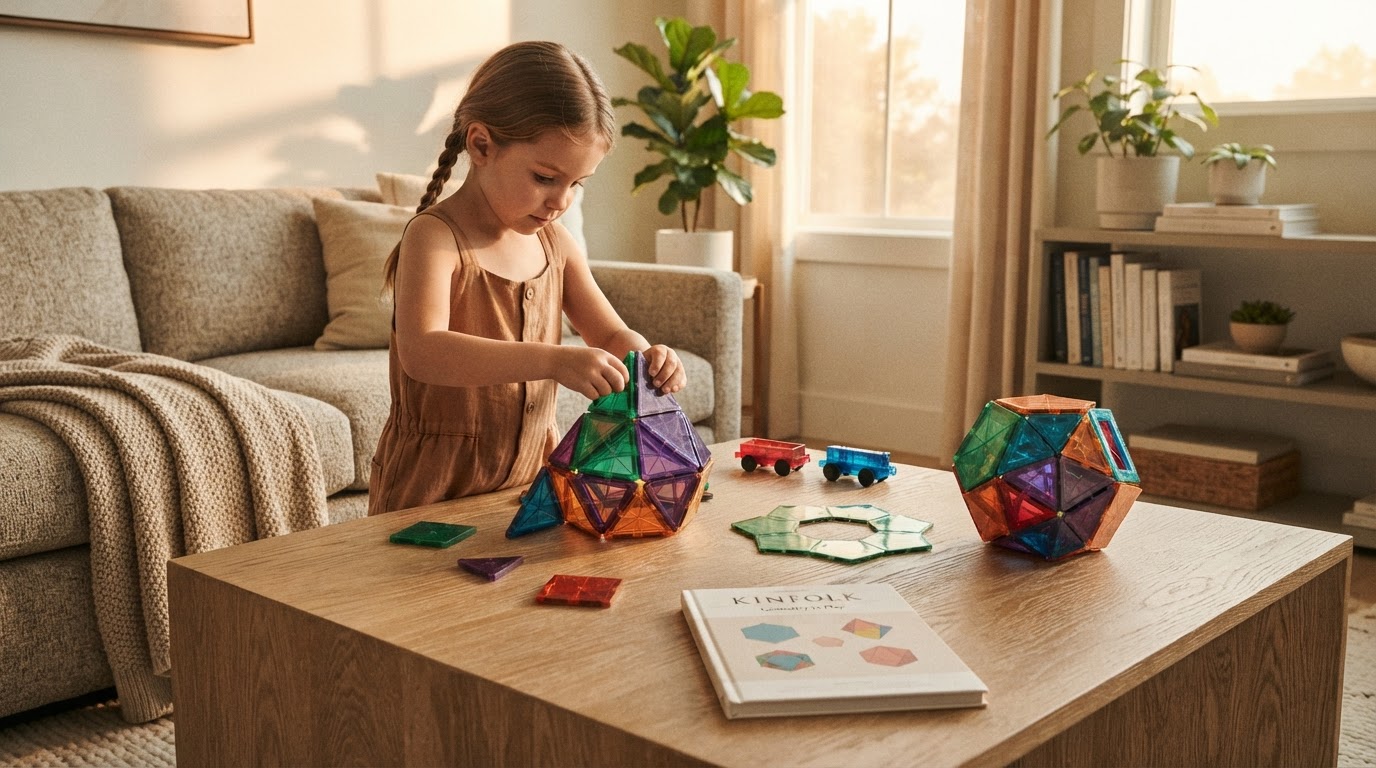
STEM Magnetic Tiles serve as a primary tool for transitioning from two-dimensional identification to three-dimensional construction. By laying tiles flat on a surface, children identify basic polygons such as squares, equilateral triangles, and isosceles triangles. The decision rule for identifying these shapes often relies on the tactile feedback of the magnetic edges aligning. As noted by Learning Resources, utilizing specific kits for basic geometric figures allows children to cut to the chase and learn through direct play.
Once a child masters the 2D layout, they can lift the central tile to watch the magnets pull the side faces together, creating a cube or a pyramid. This process, often referred to as 'net building,' is a core component of early geometry. The 3-axis model of height, width, and depth becomes visible rather than theoretical. By manipulating these tiles, students explore how multiple square faces form a cube or how four triangles create a tetrahedron. This hands-on approach is supported by educational content such as Learn Shapes with Building Blocks, which emphasizes using real-life examples and building blocks to solidify shape recognition in toddlers. Through this method, the transition from a flat plane to a volumetric object is internalized through repeated assembly.
How do these tiles improve spatial reasoning in early learners?
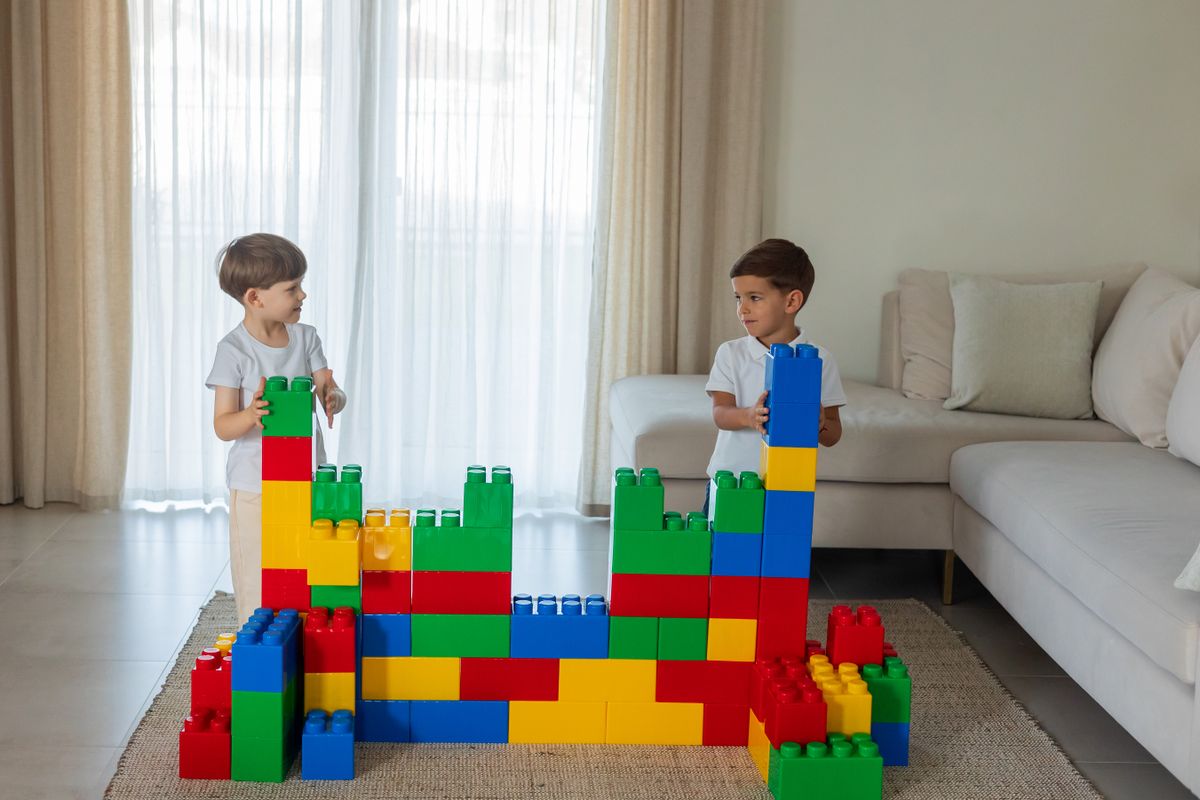
Photo by Polesie Toys on Pexels
STEM Magnetic Tiles enhance spatial reasoning by requiring the user to predict how different shapes will interact when joined at various angles. Two axes matter here: symmetry and structural stability. When a child attempts to build a complex structure, they must account for the weight distribution and the magnetic polarity of the tiles. This requires a mental rotation of objects, a skill that is fundamental to advanced mathematics and engineering.
Constructive Playthings highlights that geometric shapes building sets, which include sticks and curves, allow students to explore endless opportunities for building circles and cylinders alongside standard polygons. While magnetic tiles focus primarily on flat-faced shapes, they provide the necessary foundation for understanding how these faces occupy space. In a classroom setting, these tiles are often integrated into larger projects. For instance, the STEM Magnetic Tiles Kindergarten Village Framework demonstrates how individual geometric units are aggregated to form complex community structures. This scaling from a single tile to a STEM Magnetic Tiles Light Table Village Project reinforces the concept that all large structures are composed of smaller, identifiable geometric parts. The ability to visualize the internal volume of a structure while looking at its exterior shell is a sophisticated spatial skill developed through this specific type of open-ended play.
Quick answers
Q: What is the recommended age for starting geometric play with STEM Magnetic Tiles? A: Most manufacturers, including STEM Magnetic Tiles, recommend these sets for children ages 3 and up due to the dexterity required and safety standards. At this stage, children begin moving from simple stacking to intentional shape creation.
Q: How many different shapes are typically found in a standard set? A: A standard STEM Magnetic Tiles set usually includes at least 5 distinct geometric shapes, including large squares, small squares, and three types of triangles (equilateral, right, and isosceles). This variety allows for the construction of almost any basic Platonic solid.
Q: Can magnetic tiles be used to teach fractions? A: Yes, by using the tiles as visual area models, educators can show how two right triangles form a single square, effectively demonstrating that a whole can be partitioned into equal halves. This tactile division is a common strategy in classroom stem activities kindergarten village settings.
Learn more about STEM Magnetic Tiles at https://stemmagnetictiles.com.
Sources

Photo by Polesie Toys on Pexels
- Geometric Shapes Building Set
- Basic Geometric Figures
- Learn Shapes with Building Blocks | Easy Shape Learning for ...