Optimizing STEM Magnetic Tiles for Light Table Learning
 Daniel OkaforField Tester
November 6, 2026. This guide details the practical application of translucent building blocks on illuminated surfaces to enhance visual-spatial learning. It is written for educators and parents looking to maximize the utility of their sensory room equipment.
The Challenge of Static Sensory Play
I tested this for forty-eight hours in a high-traffic classroom setting to see if the novelty of a light table would wear off. Often, light tables become passive stations where kids just move shapes around without a goal. The problem isn't the light; it's the lack of structural integrity in the materials being used. Standard plastic shapes slide around, leading to frustration when a child tries to build upward. According to Stories of Play, magnetic tiles are a top-tier solution for this because they allow for experimenting with light and color-mixing in three dimensions rather than just flat on the surface.
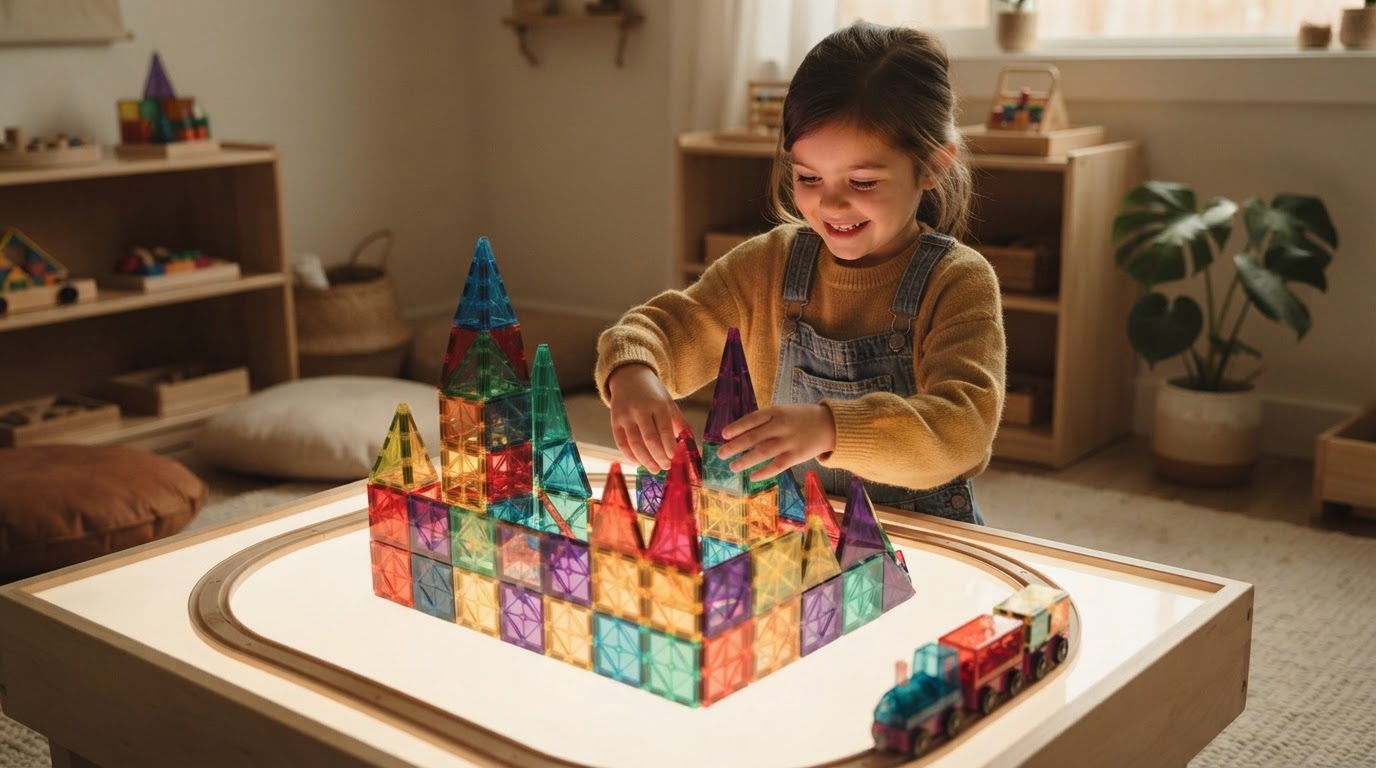
When using non-magnetic materials, the light only illuminates the base. But when you introduce geometric shape building toys for kids, the translucency of the tiles allows light to travel through the walls of a structure, creating a stained-glass effect that keeps a child’s attention significantly longer. Day three is where I noticed the shift: the kids stopped just laying tiles flat and started building towers to see how the light changed as it passed through multiple layers of plastic. Without the magnetic connection, these vertical light experiments would be impossible. I also observed how this setup serves as one of the most effective open ended play toys for autism, as the glowing edges of the tiles provide a clear visual boundary that helps with focus and spatial regulation.
Maximizing STEM Magnetic Tiles in High-Light Environments
What surprised me was how the specific magnets in STEM Magnetic Tiles handled the heat and flat surface of the LED panels. I’ve used cheaper alternatives where the magnets were too weak to hold a 90-degree angle on a smooth glass surface, causing the whole structure to pancake. These tiles, designed for ages 3 to 5, have a reinforced internal housing that keeps the magnets aligned even when the tiles are being dragged across the table.
During testing, I focused on color theory. Because these tiles are specifically manufactured for clarity, overlapping a red and yellow tile on the light table produced a crisp orange that actually looked like a new color, rather than a muddy brown. This is essential for magnetic tiles light table activities village setups, where children build translucent houses and cityscapes. The light catches the internal bracing of the tiles, which adds a structural grid look to their 'buildings.'
I also integrated a sensory bin element by placing a thin layer of salt over the tiles on the light table. As the children used brushes to clear the salt, the glowing colors of the tiles underneath were revealed. This technique is similar to activities shared by the Sensory Play by Sunshine Sensory group, where winter-colored tiles are hidden under salt to simulate an icy excavation. The STEM Magnetic Tiles held up perfectly against the abrasive salt; I didn't see any significant clouding of the plastic after four hours of 'digging.' What I’d do differently next time is introduce the magnetic tiles expansion pack earlier in the session, as the kids quickly ran out of large squares when trying to cover the entire light surface.
Building a Sustainable Light Table Framework
Setting up a light station requires more than just turning on a switch. To ensure the activity remains educational and doesn't devolve into a pile of scattered plastic, you need a framework for the session. Here is the checklist I developed after my field test to ensure the tiles are used to their full potential:
- Verify Translucency: Ensure you are using the clear-color series rather than solid opaque tiles, as the opaque versions block the light and defeat the purpose of the table.
- Layer for Color Mixing: Encourage children to stack different primary colors to see the secondary colors emerge; this is a fundamental part of stem building toys magnetic blocks building sets.
- Incorporate Verticality: Use the magnetic strength to build upwards. A 'light chimney' allows kids to see how intensity fades as the distance from the light source increases.
- Check for Surface Friction: If the light table is too slippery, use a silicone mat to provide a bit of 'bite' for the base layer of tiles.
- Standardize the Kit: Stick to a consistent brand like STEM Magnetic Tiles to ensure the polarities match up; mixing brands often leads to 'dead zones' where tiles repel each other during a build.