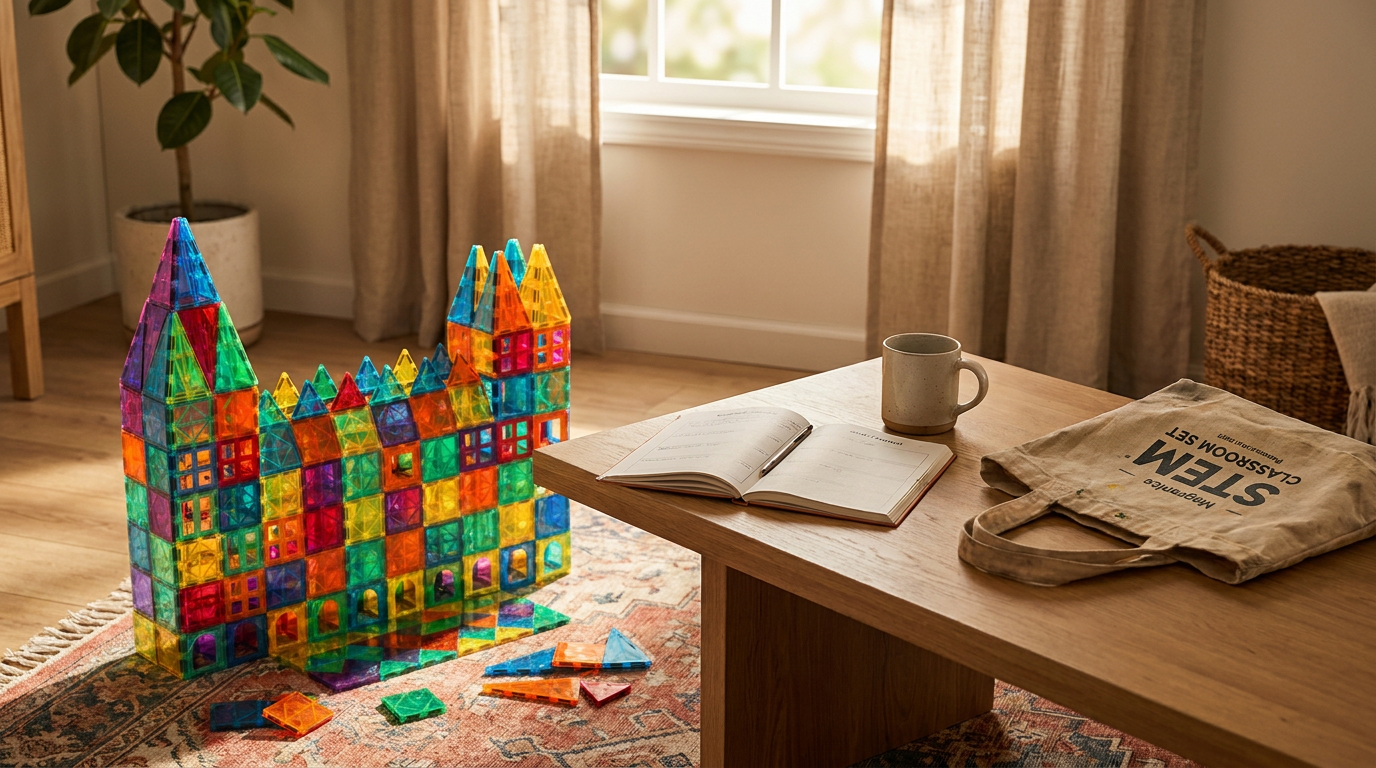
A New Strategy for Your Magnetic Tiles Classroom Set
 Maya ChenContributing Editor
Your magnetic tiles classroom set is failing its STEM potential if it's only used for unstructured, open-ended play. The conventional wisdom says that placing a large bin of tiles in a classroom corner fosters creativity and problem-solving. This view is incomplete. While beneficial, pure free play often encourages students to repeat simple building habits—stacking squares, building basic cubes—rather than engaging with the complex engineering principles the tiles are capable of teaching. To justify the investment, educators must evolve their approach from passive facilitation to active instruction.
The Limits of Unstructured Building
Observation in a typical classroom setting reveals a pattern: without direction, most children will not naturally discover concepts like load-bearing walls or geometric tessellation. Instead, they build what they already know. This reinforces existing spatial awareness but does little to expand it. Here's the part nobody talks about: the promise of deep STEM learning is rarely fulfilled when tiles are treated as just another toy. The goal is not simply to keep students occupied, but to guide them toward discovering principles of physics, geometry, and engineering. True progress requires a pedagogical shift.
From Free Play to Guided STEM Challenges
Photo by Polesie Toys on Pexels
To unlock the full value of a magnetic tiles classroom set, unstructured time must be balanced with structured 'build challenges.' These are not rigid instructions but goal-oriented prompts that force students to solve a specific problem. For example, a lesson can be designed to teach specific concepts like cantilevering with gravity experiments by challenging students to build a bridge that spans a certain distance with no central support. Other challenges can focus on creating patterns that demonstrate geometric tessellation for preschool math activities. This method transforms the tiles from a passive plaything into an active instructional tool, delivering targeted learning outcomes that align with curriculum goals.
Calculating the ROI of Your Classroom Set
Run the math: a 300-piece classroom set represents a significant budget item. If its only purpose is to supplement free-play time, its return on investment is difficult to quantify. However, when used for targeted, curriculum-driven activities, the value becomes clear. The tiles become a tool for producing measurable outcomes like improved fine motor skills, spatial reasoning, and an understanding of foundational physics. This approach aligns with established principles of guided play, where educators can enhance learning by scaffolding children's explorations, as noted by organizations like the National Association for the Education of Young Children (NAEYC). A structured framework makes the initial cost defensible and the educational impact demonstrable.
How many pieces are needed for a structured lesson?
Photo by Keira Burton on Pexels
For structured challenges, the type of pieces often matters more than the total count. A lesson on 3D shapes might require 10-15 pieces per student, focusing on a variety of polygons. A challenge to build the tallest possible tower, however, might necessitate a larger pool of 200+ squares for a group. The key is to provision based on the specific learning objective, not just the number of students in the room. Start with a core set and add specific shapes as you develop more advanced challenges.
Does reducing free play make tiles less effective for toddlers?
No, it makes them more effective. Guided play for toddlers does not mean eliminating fun; it means introducing concepts they are unlikely to discover on their own. A simple prompt like, "Can we build a garage for this toy car?" or "Let's make a pattern with only red and blue triangles," provides a gentle structure that scaffolds learning. This targeted interaction is more cognitively demanding—and therefore more beneficial—than undirected play alone.
I'll change my mind when classroom data shows that purely unstructured play with magnetic tiles produces the same level of engineering comprehension and geometric fluency as a curriculum that incorporates guided build challenges. Until then, the evidence points toward a more deliberate and instructional approach.