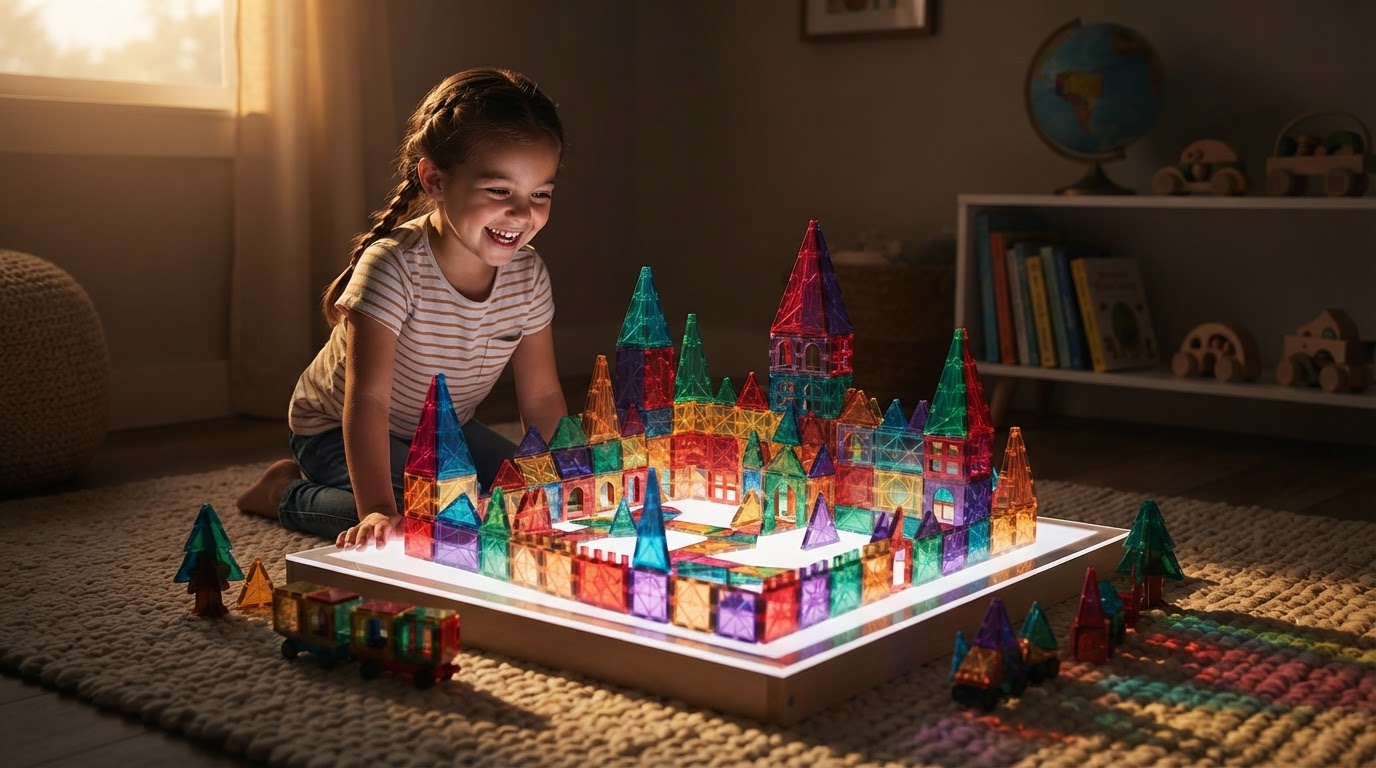
Building Luminous Villages with STEM Magnetic Tiles
 Maya ChenContributing Editor
October 5, 2026. This technical analysis explores the construction of luminous architectural villages using translucent magnetic components on a light source. It is designed for educators and parents seeking to maximize the utility of STEM Magnetic Tiles in high-contrast sensory environments.
The Light Table Saturation Problem
The conventional wisdom says that any translucent toy placed on a light table automatically generates educational value. This is a fallacy. Most light table activities remain shallow because they lack the structural integrity to move beyond 2D flat-laying. According to Play to Learn Preschool, moving magnetic components to the light table is a fantastic way to engage students while providing a fulfilling sensory experience, but the engagement often plateaus if the materials cannot sustain complex verticality. In many early childhood settings, light tables are relegated to simple color-sorting tasks that fail to utilize the physical properties of the light itself. The primary issue is light diffusion; without high-quality magnets, 3D structures like villages collapse under their own weight, frustrating the user and ending the sensory exploration prematurely. Furthermore, the common practice of using flimsy plastic blocks often results in "light bleed" that washes out the geometric boundaries, making it difficult for children to distinguish between different shapes and angles. This lack of precision undermines the core purpose of a light table, which should be to highlight the intersection of geometry and optics.
Structural Integrity in Luminous Village Design
STEM Magnetic Tiles address these structural deficiencies through specific engineering choices that differentiate them from standard translucent blocks. When constructing a village—which requires stable multi-story dwellings, peaked roofs, and interconnected walkways—the magnetic flux density of the tiles becomes the deciding factor in project success. These tiles utilize reinforced internal magnets that allow for the creation of complex [geometric shape building toys for kids](/blog/geometric-shape-building-toys-for-kids) without the structural failure common in budget alternatives. The translucency of the ABS plastic used in these sets is tuned specifically for light tables; it maintains color saturation even when backlit by high-intensity LEDs. This is critical for magnetic tile light table activities where color mixing is a primary learning objective. As noted by Stories of Play, the translucent nature of high-quality tiles allows light to pass through beautifully, enabling toddlers to see how different colors mix to make new ones and how light creates shadows. For a village build, this means a blue tile wall and a red tile wall can intersect to create a purple glow in the corner of a "house," providing a real-time lesson in additive color theory. The durability of the sonic-welded edges ensures that even during intense, [open ended play toys for autism](/blog/open-ended-play-toys-for-autism) sessions, the tiles remain safe and functional.
Decision Framework for Village Construction
Building a sustainable village requires more than just piling blocks; it requires a systematic approach to balance and light distribution. Here's the part nobody talks about: the height of your light table village is limited by the base-layer surface area, not the strength of the magnets. If the base isn't wide enough, the center of gravity shifts too far during the addition of roof tiles. When selecting tiles for this specific activity, run the math on your surface-to-height ratio to ensure stability. Use this checklist to evaluate your setup:
- Verify that the magnetic tiles feature internal bracing to prevent the plastic from bowing under the heat of the light table.
- Ensure the set includes a variety of isosceles and right-angled triangles to facilitate architectural diversity in rooflines.
- Prioritize tiles with high-clarity finishes to minimize light refraction distortion.
- Standardize on a single brand to ensure magnetic polarity alignment across all village sections.
- Incorporate large square tiles as foundational floor plates to distribute weight evenly across the light panel.
Shop STEM Magnetic Tiles here: https://stemmagnetictiles.com
Sources
- Have you tried magnetic blocks on the light table? My students love it ...
- Magna-Tiles on the Light Table - Play to Learn Preschool
- The No. 1 Toy in Our House: 10 Ways My Kids Play With Magnetic Tiles